
Business Trust: The Advantage That Comes from Operations

Business trust is not built through promises. It is demonstrated every day through the way a company operates.
Every business invests time and resources in strengthening its brand. However, most still believe that trust depends primarily on marketing, advertising, or a good sales strategy.
The reality is different. Business trust begins long before a customer signs a contract and continues long after a sale is closed. It is built into every internal process, every decision, and every interaction that demonstrates an organization’s ability to deliver on its promises.
In an environment where artificial intelligence is transforming the way we work, this reality becomes even more relevant. Technology can accelerate processes, automate tasks, and provide information in real time. However, trust still depends on the judgment with which a company decides to use it.
Marketing Creates Expectations. Operations Confirms Them.
- A campaign can capture attention.
- A salesperson can generate interest.
- A product can convince.
But operations determines whether the customer truly feels they made a good decision.
This difference often goes unnoticed because operations rarely appears in a sales presentation. It does not usually take center stage in marketing campaigns or become the focus of a conversation. However, it is where a company demonstrates whether it is prepared to grow sustainably.
When processes work, the customer barely notices them. When they fail, trust disappears quickly.
That is why operations is not simply an administrative function. It is one of the most important strategic assets for any organization.
Business Trust Is Built Where Almost No One Looks
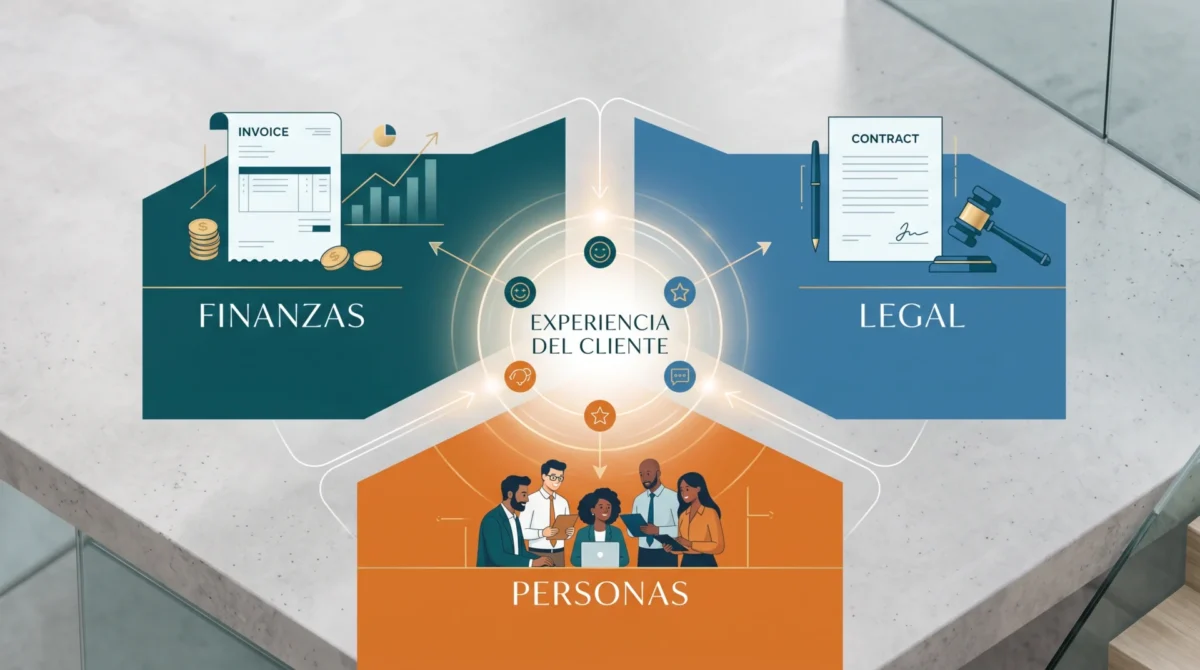
There are three areas that rarely appear in a sales pitch but support the entire customer experience.
Finance
- Charging correctly.
- Processing payments without friction.
- Maintaining transparent information.
- Fulfilling financial commitments.
Each of these processes conveys security. A customer may forget a brilliant sales presentation, but they are unlikely to forget an incorrect invoice or a complicated payment process.
Legal
Contracts represent much more than a legal requirement.
They are the way a company protects both its interests and those of its customers.
When rules are clear, processes are transparent, and traceability exists, the business relationship begins on a much stronger foundation.
People
The way an organization manages its team also ultimately impacts the customer.
- Well prepared teams respond better.
- Clear processes reduce errors.
- A culture based on accountability creates better experiences.
Although the customer never sees these processes, they do perceive their results.
And that perception ultimately strengthens or weakens business trust.
A Mature Operation Is Not One That Never Fails
There is a misconception about operational excellence.
Many companies believe that maturity means never making mistakes.
In reality, the opposite is true.
The strongest organizations are not those that never make mistakes. They are those that quickly identify an error, understand why it happened, and build processes to prevent it from happening again.
This continuous learning turns every experience into an opportunity to strengthen operations.
Continuous improvement stops being a temporary project and becomes part of the organizational culture.
And that culture is much harder to copy than any technology.
AI Changes Speed. Judgment Remains Human.
Talking about artificial intelligence no longer means talking about the future.
Today, it is part of commercial, financial, legal, and operational areas.
However, the real debate is no longer whether a company should adopt AI.
The right question is different:
How can it be done without losing human judgment?
Artificial intelligence can analyze large volumes of information, automate repetitive processes, and reduce execution times.
But there are decisions that still require context, experience, and judgment.
That is why the conversation should not focus on replacing people, but on enhancing their ability to dedicate more time to what truly generates value.
This is precisely the approach driving platforms such as BIKY.ai, designed to automate sales operations through Emotional Artificial Intelligence. Instead of limiting itself to responding to conversations, it integrates data, processes, automations, metrics, and AI salespeople into a single source of information so companies can operate with greater consistency, traceability, and control. The goal is not to replace human judgment, but to free the team to focus on strategy, relationships, and higher impact decisions.

Automation Does Not Mean Losing Control
One of the biggest fears surrounding AI is the idea that automation means completely handing decisions over to technology.
Reality shows the opposite.
The most advanced organizations use AI to strengthen their processes, not to eliminate oversight.
- They automate repetitive tasks.
- They connect scattered information.
- They detect patterns that previously went unnoticed.
- They generate more accurate metrics.
But they maintain clear rules around what requires human validation.
This balance makes it possible to move faster without sacrificing trust.
Because when AI operates under defined processes and measurable objectives, it stops being simply a technological tool and becomes an operational advantage.
Business Trust Will Be One of the Most Important Competitive Advantages
For years, many companies competed on price.
Others competed on product.
Then came competition based on customer experience.
Now a new stage is beginning.
Organizations will compete based on the trust they are capable of generating.
Not only through what they communicate.
Also through how they execute.
In a market where customers expect immediate responses, transparent processes, and consistent experiences, operations stops being a support area and becomes a strategic growth factor.
Technology will continue to evolve.
Artificial intelligence will continue to accelerate processes.
But trust will continue to be a business decision.
Because, ultimately, a customer does not only buy a product or a service.
They buy the certainty that the company knows how to deliver on what it promises.