
Operational acceleration: grow without making your company more complex

Growth should make a company stronger. However, it often only makes it slower, more expensive, and harder to operate.
For a long time, growth seemed to follow a simple formula: acquiring more customers, hiring more people, and increasing investment.
It works. Up to a point.
Because every new customer also generates more conversations, more data, more campaigns, more decisions, and more operational work. If the company grows faster than its ability to manage all of that, efficiency starts to decline.
That is where operational acceleration acquires its true value.
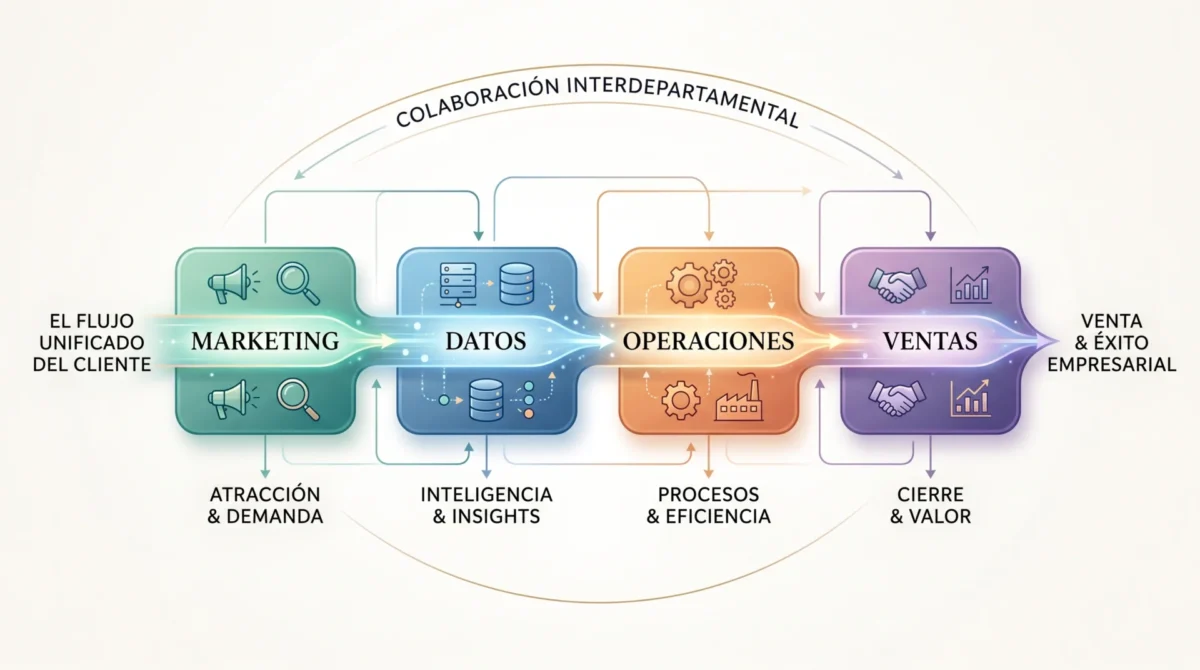
It does not simply mean working faster. It means getting marketing, sales, data, and operations to work as a system capable of executing, measuring, and learning.
Growth Can Also Increase Inefficiency
Let us imagine a common situation.
Marketing generates 1,000 opportunities. Sales receives those contacts, but some take too long to be handled. Others arrive without enough information. Some are assigned incorrectly, and others are simply forgotten.
Marketing may say:
“We are generating opportunities”.
Sales may respond:
“The opportunities are not high quality”.
And management ends up asking:
Where is the money being lost?
The problem may not lie with either of the two teams.
It may lie in the connection between them.
A company does not grow by departments. It grows when everything that happens between the first interaction with a customer and a sale works properly.
That is why, when marketing, sales, data, and operations work as isolated units, growth can bring more volume, but also more friction.
More Technology Does Not Mean a Better Operation
Companies today have more tools than ever: CRM systems, advertising platforms, automations, analytics, and artificial intelligence.
But having more technology does not guarantee having a better operation.
A company can incorporate new tools and maintain exactly the same problems: fragmented data, manual processes, opportunities without follow up, and teams that spend time searching for information instead of using it.
That is why, before asking what tool needs to be incorporated, there is a more useful question:
Where are we losing time, opportunities, or information?
The answer makes it possible to decide what really needs to change.
Because technology can accelerate a well designed process. But it can also make a process that already works poorly run faster.
What Does Operational Optimization Really Mean
Operational acceleration consists of turning a growth strategy into an operation that can execute and measure it.
This means observing how the company works, identifying where losses occur, prioritizing changes, and taking them into the operation.
The difference compared with consulting based solely on recommendations is important.
A recommendation may say:
“We need to improve opportunity follow up”.
Operational acceleration asks an additional question:
How do we make that follow up happen consistently?
That is why the process must move from diagnosis to implementation and then to measurement.
The result is not just a document. It can be a functioning process, a dashboard, an automation, an integration, or a playbook that the team can use.
Strategy gains value when it can be executed.
The Real Cost Lies in the Time the Operation Wastes
One of the hardest costs to see in a company does not necessarily appear on an invoice.
It appears in time.
People copying information from one system to another. Salespeople searching for data before contacting a customer. Marketing trying to discover which campaigns generated sales. Executives waiting for reports to make decisions.
Each task seems small.
But multiplied across hundreds of interactions and an entire team, it can represent a considerable amount of lost capacity.
Here, artificial intelligence can play a particularly relevant role.
Not to replace human judgment, but to reduce the repetitive work that prevents people from focusing on where they truly add value: understanding the customer, selling, analyzing, deciding, and solving problems.
The goal is not to do more. It is to waste less.
From Measuring Activity to Measuring Impact
An operation prepared for growth also needs to change the way it measures its performance.
Getting more leads does not necessarily mean getting more business.
A company can increase traffic without increasing its sales. It can generate more conversations and reduce the quality of opportunities. It can invest more in advertising and end up paying more for each customer.
That is why volume metrics need to be complemented with impact metrics.
It is not enough to ask:
How many did we get?
We also need to know:
How many moved forward? How long did it take us to attend to them? How many bought? Which investment generated better customers? Where were the opportunities lost?
The difference is important in an economy where capturing customer attention costs more and more.
True efficiency appears when a company can connect the entire journey:
campaign → conversation → opportunity → sale → revenue.
In this way, data stops being merely information and becomes a decision making tool.

NITRO: Turning Diagnosis into Execution
Here is where NITRO comes in, the operational acceleration offering from BIKY.ai.
NITRO starts from a simple premise: speed does not come from having more tools, but from getting people, data, and processes to work better together.
Its approach combines diagnosis, design, and implementation to identify what is slowing growth and turn that diagnosis into measurable operational improvements.
The process can be summarized in three stages:
Diagnose. Understand the funnel, channels, data, stack, timelines, and main points of friction.
Design. Prioritize opportunities, define KPIs, responsibilities, rules, and an execution roadmap.
Execute. Implement processes, integrations, automations, dashboards, and playbooks together with the team.
The value lies precisely in this last step.
NITRO does not seek to leave a list of recommendations for the company to figure out later how to implement them. It seeks to help turn them into an operation that can function and continue improving.
An Operation Prepared for Growth Learns Faster
Companies should not need a major transformation every time a problem arises.
A mature operation learns in short cycles:
detect → test → measure → learn → improve.
This cycle makes it possible to reduce dependence on extraordinary efforts and build processes that can be repeated.
It also makes it possible to take better advantage of artificial intelligence.
Because an intelligent tool within a disorganized operation can automate part of the problem.
In contrast, an intelligent tool within a well designed system can multiply the team’s capacity.
That is why the strategic question should not only be how much a company wants to grow.
It should also be:
Is our operation prepared to support that growth without increasing complexity, costs, and team strain at the same rate?
The answer can make the difference between growing by doing more and growing by operating better.
Operational Efficiency as an Advantage for the Next Growth Cycle
Sustainable growth does not depend solely on acquiring more customers.
It depends on the company being able to absorb that growth without losing speed, information, or decision making capacity.
Operational acceleration seeks precisely that balance: connecting teams, data, and processes so that revenue can grow alongside the organization’s ability to operate it.
Before planning how much a company wants to grow, there may be a more important question:
How much growth can our operation support without becoming slower, more expensive, and more complex?
For BIKY.ai, that is the logic behind NITRO: turning diagnosis into execution and helping the operation not only grow, but learn to grow better.