
The company that detects the problem first wins in the market
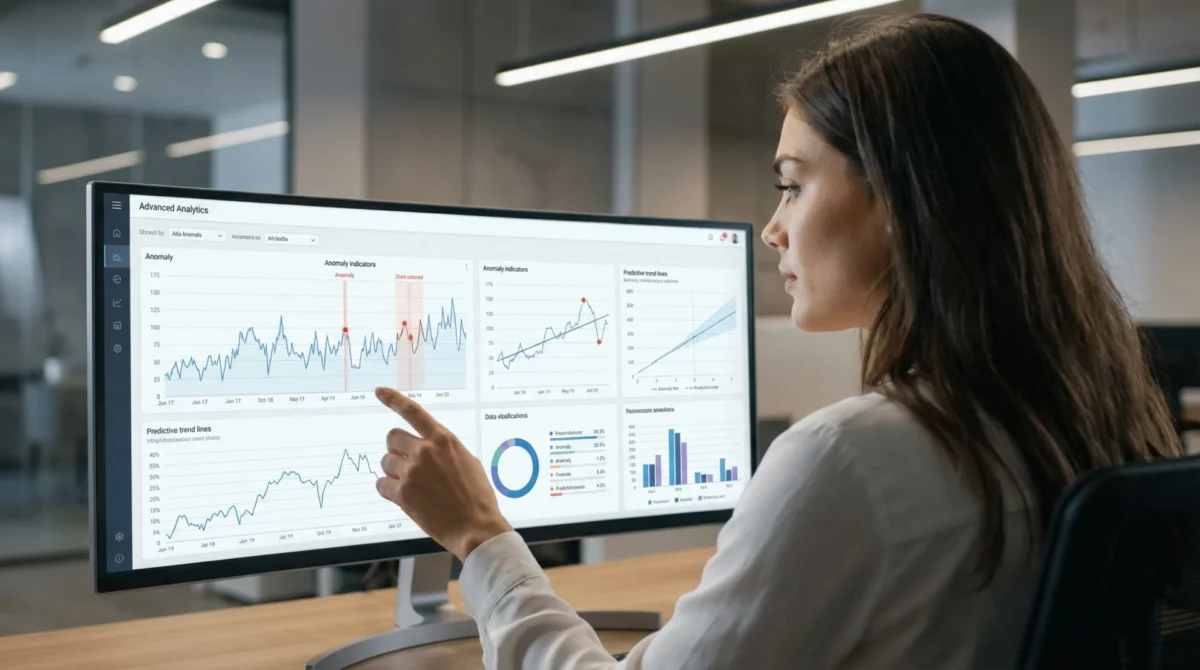
Most companies analyze their sales by looking at the past. Monthly reports, historical dashboards, performance reviews. The problem is simple: when the data confirms a decline, the damage has already been done. The new advantage lies not in understanding what happened, but in anticipating what is about to happen.
For years, commercial analytics focused on answering retrospective questions: how much did we sell, which channel performed best, which campaign generated the most revenue? Now, predictive analytics is transforming the way companies anticipate future outcomes.
The traditional approach was useful in more stable environments, where changes were gradual and reaction time did not determine the business outcome.
Today the landscape is different. Purchase decisions happen in minutes, customer attention is volatile, and market behavior shifts constantly. In this context, post-analysis loses strategic value.
When a company detects a drop in conversion weeks later, it has already lost opportunities, revenue, and positioning. The current challenge is not observing improvement opportunities. It is anticipating them.
From historical analysis to real-time operational intelligence
The traditional analytics model works as an observation system:
- Data is generated
- Reports are consolidated
- Trends are analyzed
- Decisions are made
This cycle introduces structural delays because information arrives after behavior has already changed or after valuable sales opportunities have been lost.
A predictive analytics approach reverses this logic:
- Operations are continuously monitored
- Anomalies are automatically detected
- Early alerts are generated
- Immediate intervention becomes possible
Analytics stops being a diagnostic tool and becomes a model of anticipation.
Predictive analytics in sales
Analytics and predictions in commercial environments involve identifying patterns, detecting deviations, and projecting outcomes before they materialize.
This includes:
- Detecting atypical funnel behavior
- Early identification of conversion drops
- Analyzing trends in purchase intent
- Predicting commercial outcomes
- Automatically generating operational alerts
The goal is not to explain the past but to modify the future.
The cost of reacting late
When an organization responds late to sales changes, consequences accumulate:
- Lost pipeline opportunities
- Inefficient campaigns running for weeks
- Incorrect resource allocation
- Decisions based on outdated information
From an economic perspective, delayed detection equals direct revenue loss. Reaction speed becomes the true competitive advantage.

BIKY.ai and predictive analytics as a commercial alert system
Within its sales platform, BIKY.ai integrates an analytics module designed to monitor commercial operations in real time, detect anomalies, and generate actionable insights.
Its approach combines:
- Conversational analysis
- Operational metrics
- Customer behavior monitoring
- Intelligent alert generation
This allows brands to act before problems escalate and transforms analytics from a report into a mechanism for continuous decision-making.
Before and after: static reports vs. proactive intelligence
Traditional model
- Monthly or weekly analysis
- Manual interpretation
- Delayed reaction
- Limited visibility of the real process
Predictive analytics model with BIKY.ai
- Continuous monitoring
- Automatic anomaly detection
- Real-time alerts
- Anticipated decisions
The fundamental difference is temporal: acting before instead of reacting afterward.
Anomaly detection: identifying signals invisible to the human eye
One of the greatest contributions of advanced analytics is automatic anomaly detection.
In complex operations, relevant changes are often subtle:
- A slight decrease in response rate
- A gradual increase in decision time
- Changes in conversational behavior
- Variations in customer questions
These patterns often go unnoticed in manual analysis but may signal structural issues.
BIKY.ai identifies these deviations and alerts the organization to intervene in time.
Operational example: anticipating a conversion drop
Imagine a company selling through conversational channels. A traditional system would detect the issue weeks later, when monthly conversion declines.
A predictive analytics system detects earlier:
- Increase in customer doubts
- Longer time between interaction and decision
- Shift in frequent objections
- Lower engagement in final stages
The organization can adjust strategy before the impact becomes significant.
The attention economy and customer behavior
Modern analysis must recognize that customer behavior is influenced by dynamic factors:
- Information saturation
- Context shifts
- Changing priorities
Conversational analytics makes it possible to observe how customer attention evolves in real time. This provides a strategic advantage: understanding not only what customers buy, but how they decide.

Quantitative and qualitative metrics in one system
Traditional dashboards focus on numeric metrics:
- Sales volume
- Close rate
- Average value
But customer decisions also depend on qualitative factors:
- Intent
- Emotion
- Context
- Objections
BIKY.ai predictive analytics integrates both dimensions through interaction analysis, enabling a more complete understanding of commercial behavior.
Prediction as a strategic planning tool
The ability to anticipate results transforms business planning.
It enables you to:
- Project revenue more accurately
- Adjust resources in advance
- Optimize marketing investment
- Prioritize opportunities with higher closing probability
Predictability reduces uncertainty and improves operational efficiency.
Freeing the human team from manual analysis
Manual analysis consumes time and limits reaction capacity. By automating data interpretation, the team can:
- Focus on strategic decisions
- Design improvements to the commercial process
- Optimize customer experience
BIKY.ai does not replace human judgment. It amplifies it.
BIKY.ai predictive analytics as a competitive advantage
Companies historically competed on:
- Product
- Price
- Distribution
Today they also compete on interpretation capacity.
Whoever detects market changes first adjusts strategy first.
Whoever adjusts first captures more opportunities.
Predictive analytics redefines competition.
From post-mortem review to continuous improvement
Many organizations analyze problems after they occur:
- Why did conversion drop?
- Why did the campaign fail?
- Why were customers lost?
This approach limits learning capacity.
The predictive model of BIKY.ai enables continuous improvement by allowing organizations to:
- Detect early signals
- Adjust processes
- Prevent losses
The organization evolves constantly.
The future belongs to those who see first
Sustainable growth does not depend entirely on selling more. It depends on understanding earlier what is changing.
Integrated analytics and predictions within BIKY.ai transform data into anticipatory decisions, reduce uncertainty, and improve the efficiency of the entire commercial operation.
When an organization stops looking only at the past and begins interpreting the present in real time:
- Decisions accelerate
- Risks decrease
- Customer experience improves
- The business scales with greater stability
In dynamic markets, the advantage is not having additional information. It is knowing what to do with it before others do.
The company that detects first decides first.
And the one that decides first leads.