
Outbound marketing integrated with the CRM: every message should drive a sale, not just be sent

The problem is not sending too few messages. The problem is sending messages that change nothing. When outbound connected to the CRM truly works, every send leaves a trace, triggers action, and moves a sale closer.
For years, many companies confused outbound with volume. More campaigns, more databases, more emails, more WhatsApp messages, more touchpoints. However, sending communications never guaranteed more sales. In fact, in many cases it only multiplied the noise, because the real value of outbound connected to the CRM is not in the number of messages sent, but in the ability to turn every contact into a manageable opportunity.
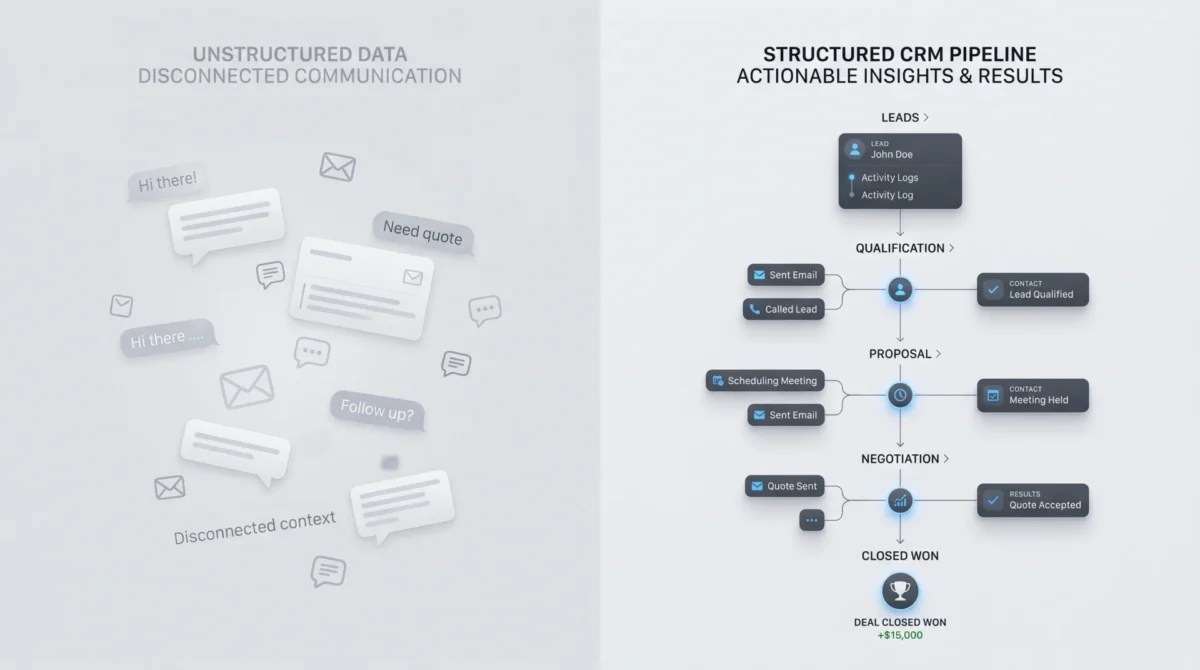
Most outbound strategies fail for one simple reason: the message goes out, but the operation does not continue. The customer replies and no one responds. They click and there is no follow up. They show interest and the CRM is never updated. That is where money is lost.
For this reason, BIKY.ai proposes a different approach. Turning messaging into an operational layer connected to the CDP, the CRM, and the commercial funnel so that every reply activates follow ups, activities, appointments, and measurable results.
It is not about communicating more. It is about moving sales with precision.
The historical mistake: treating outbound as isolated marketing
Many companies still operate outbound as if it were a task separate from the business. Marketing designs campaigns. Sales waits for leads. Operations tries to organize the chaos afterward.
That fragmentation creates a costly consequence: no one can clearly explain which message produced which result.
An email may be opened and lead to nothing, a WhatsApp message may generate interest and get lost due to lack of response, and an SMS may arrive at the perfect moment but remain disconnected from the sales process. When channels live separately from the CRM, learning breaks as well.
That is why BIKY.ai redefines outbound as commercial activation, not simple sending. Its module connects WhatsApp, SMS, and email with segments, signals, opportunities, and results so every interaction becomes part of the sales system.
The difference is profound: the message stops being a marketing action and becomes a revenue action.
What outbound connected to the CRM really means
Connecting outbound to the CRM is not just saving a record that “something was sent.” That would be a minimal and not very useful version of the concept. Real connection happens when every message can influence the funnel and trigger the next automatic or human action.
That implies several layers:
- Knowing who receives the message and why
- Adapting the channel and message based on context
- Recording opens, replies, or interactions
- Creating activities or tasks
- Moving commercial stages
- Measuring impact on conversion
BIKY.ai works precisely on that logic. It uses unified identity, history, intent, and stage to activate messages through WhatsApp, SMS, and email. And when the customer replies, the conversation does not remain floating: it enters the operational flow.
That changes the usefulness of outbound. It is no longer distribution. It is commercial execution.
Every message must have a business purpose
One of the biggest wastes in modern sales is sending messages without a clear purpose. Many campaigns exist because “it was time to send something.” Not because they responded to a real customer need or pipeline need.
A mature outbound strategy starts with concrete objectives. For example:
- Reactivating stalled leads
- Confirming appointments
- Recovering unanswered quotes
- Driving repurchase
- Accelerating close
- Reducing no shows
- Activating upsell or cross sell
When every message is born from a business purpose, measurement improves automatically. It is no longer evaluated only by open rates or clicks. It is evaluated by real impact: appointments secured, opportunities recovered, deals closed, time saved.
BIKY.ai allows this logic to be structured through segmentation by behavior, intent, stage, and lifecycle. That avoids generic campaigns and turns messaging into a strategic tool.
The biggest differentiator: when the customer replies, something happens
This is the point where many operations fail. They get the customer to reply… and then nothing happens.
That gap destroys conversions. Because the customer’s reply is a signal of intent, and intent has an expiration date.
If someone replies to a reactivation campaign, they are opening a window of attention. If no one manages it quickly, the window closes. The lead goes cold and the company blames the channel, the market, or the price.
BIKY.ai proposes a different logic: when the customer replies, the conversation becomes an operation. It can be assigned to the right salesperson, open a task, schedule an appointment, move a stage forward, or trigger automatic follow up with SLA.
That may sound technical, but it is deeply economic. Because it reduces the loss between interest and action. And that is where a large portion of wasted money lives.
WhatsApp, SMS, and Email: they do not compete, they complement each other when outbound is connected to the CRM
Another common mistake is searching for “the best channel.” In reality, the best channel depends on the moment, the context, and the type of decision you want to drive.
- WhatsApp works very well for two way conversation, quick replies, buttons, multimedia, and commercial continuity.
- SMS remains powerful in critical moments: reminders, urgent confirmations, time sensitive notices, and highly visible messages.
- Email still holds enormous value for nurturing, retention, formal processes, broader content, and lifecycle automations.
BIKY.ai integrates all three channels within a single operational layer. That allows each medium to be used where it makes the most sense, without fragmenting data or losing traceability.
The question is no longer “which channel do we use.” The right question is “which channel increases the probability of advancing this opportunity.”
From cold lead to living context
One of the biggest problems with traditional outbound is that it treats everyone the same. Same campaign, same copy, same timing, same sequence. That approach ignores something essential: not all leads are in the same moment.
A prospect who requested a quote yesterday does not need the same message as one inactive for six months. A person who already bought should not receive the same pitch as someone still hesitating, and a user who showed high intent deserves a different level of urgency.
That is why BIKY.ai includes personalization with emotional AI using profile, history, intent, and stage. Not to sound “nice,” but to increase relevance.
When the message connects with the customer’s real context, response rates rise. And when responses rise with traceability, the full funnel performs better.
Traceability: what is not measured does not improve
Many companies send campaigns for months without being able to answer basic questions:
- Which channel recovers the most opportunities?
- What type of message confirms the most appointments?
- Which segment repurchases faster?
- Which campaign generates real sales and not just clicks?
- Which salesperson converts reactivated leads better?
Without traceability, everything becomes narrative. Each department defends its perception. Marketing shows opens. Sales says the leads are worthless. Leadership does not know where to adjust.
BIKY.ai connects send, response, activity, opportunity, and result within the same system. That makes it possible to measure from message to close.
The consequence is not only better reporting. It is better decision making.
The human impact: freeing the team from repetitive work
There is a common concern when talking about automation: that technology will replace human work. In well designed commercial operations, the opposite happens.
Outbound connected to the CRM eliminates mechanical tasks:
- Exporting lists manually
- Copying contacts between systems
- Chasing forgotten follow ups
- Remembering reconfirmations
- Reviewing one by one who did not reply
- Updating statuses manually
That frees time for tasks where humans truly create advantage: negotiating, interpreting complex objections, building trust, closing deals, and detecting strategic opportunities.
BIKY.ai does not propose taking protagonism away from the salesperson. It proposes removing operational burden so they can sell better.
What changes in a company when outbound is connected to the CRM
When an organization moves from isolated campaigns to outbound connected to the CRM, visible improvements appear:
More commercial speed
Replies do not wait hours or days. They quickly become actions.
Better customer experience
The customer does not repeat context or feel abandoned between departments.
Less lead waste
Every signal of interest gets real follow up.
Accumulated learning
The company understands which messages, moments, and segments convert best.
Real scalability
Growth stops depending only on heroic salespeople or manual effort.
These improvements do not come from sending more. They come from operating better.
What commercial leadership should review in 2026
When closing budgets and planning growth, leaders should review whether their current outbound answers these questions:
- Is every send connected to a real opportunity?
- Do replies trigger immediate follow up?
- Can we attribute sales to specific campaigns?
- Are our channels working in coordination?
- Is the team investing time in selling or managing campaigns?
- Are we learning from results or repeating actions?
If the answer is no, the problem is not the market. It is the commercial architecture.
And in 2026, that will matter more than ever.
Why BIKY.ai belongs in a different category
Many tools send messages. Some automate sequences. Others offer dashboards. But few connect identity, context, conversation, CRM, funnel, and results inside one operation.
That is where BIKY.ai stands apart.
It is not presented only as an outbound channel. It positions itself as a sales platform where AI sellers, a living CRM, automation, and analytics work together. That allows the message not to end in delivery. It ends in commercial movement.
In an environment where attention is scarce and speed matters, that difference is decisive.
It is time to use outbound connected to the CRM
Outbound can no longer be measured by the number of campaigns sent or the volume of contacts reached. Those metrics say little about real growth. What matters now is something else: how many messages generate opportunities, how many opportunities advance, and how much revenue each interaction produces.
That is the value of outbound connected to the CRM. Turning messaging into traceability, traceability into decisions, and decisions into sales.
BIKY.ai proposes exactly that model. It unites WhatsApp, SMS, and email with context, automation, CRM, and funnel so every reply has an owner, a next step, and a measurable result.
As we enter 2026, many companies will keep sending campaigns. The smartest ones will build systems where every message moves a sale.