
Sales automation: Your process isn’t failing because of the technology; it’s failing because it isn’t scalable

You still think your problem is your salespeople, but sales automation reveals something uncomfortable: the real failure lies in a process that is not executable.
There is a convenient explanation many companies repeat when sales are not working: “we need better salespeople.” However, in most cases, that is not the real cause. In reality, it avoids looking deeper at solutions like sales automation.
The truth is more uncomfortable. Most teams do not fail due to lack of talent, but due to lack of sales automation. Processes that depend on memory, individual discipline and constant effort eventually break, even with good salespeople.
That is where the conversation changes. It is not about replacing people, but about redesigning how work is executed. This is why BIKY.ai shows that the problem is not who sells, but how the operation that enables selling is sustained.
The myth of the “bad salesperson”: an easy explanation for a complex problem
When an opportunity is lost, the reaction is usually immediate: review the salesperson.
- They did not follow up.
- They did not respond on time.
- They did not log the information.
All of that may be true. But the most important question is rarely asked:
Was the process designed for that to happen correctly?
Because if the commercial flow depends on someone remembering every step, it will eventually fail.
The error is not in the person. It is in a model that is not consistently executable because it does not include sales automation.
The real problem: processes designed, but not operated
Many companies have defined processes with stages, rules, playbooks and even tools. But in practice, execution is a different story.
Salespeople end up:
- Copying information between tools
- Sending messages manually
- Remembering follow ups
- Prioritizing without clear data
The process exists in theory, but it is not executed reliably. That is where the consistency that sustains conversion is lost.
Sales automation: when the process stops depending on memory
Sales automation is not about integrating tools or creating more dashboards. It is about something more fundamental: turning rules into execution.
An automated process does not ask whether someone followed up, it simply does it. It does not depend on someone updating the CRM, it updates automatically. It does not wait for someone to act, it is triggered by events.
That completely changes the operational dynamic. At BIKY.ai, we have FLOWS, a module fully dedicated to no code automation that helps you create visual flows focused on sales, connecting conversation, funnel and external systems.
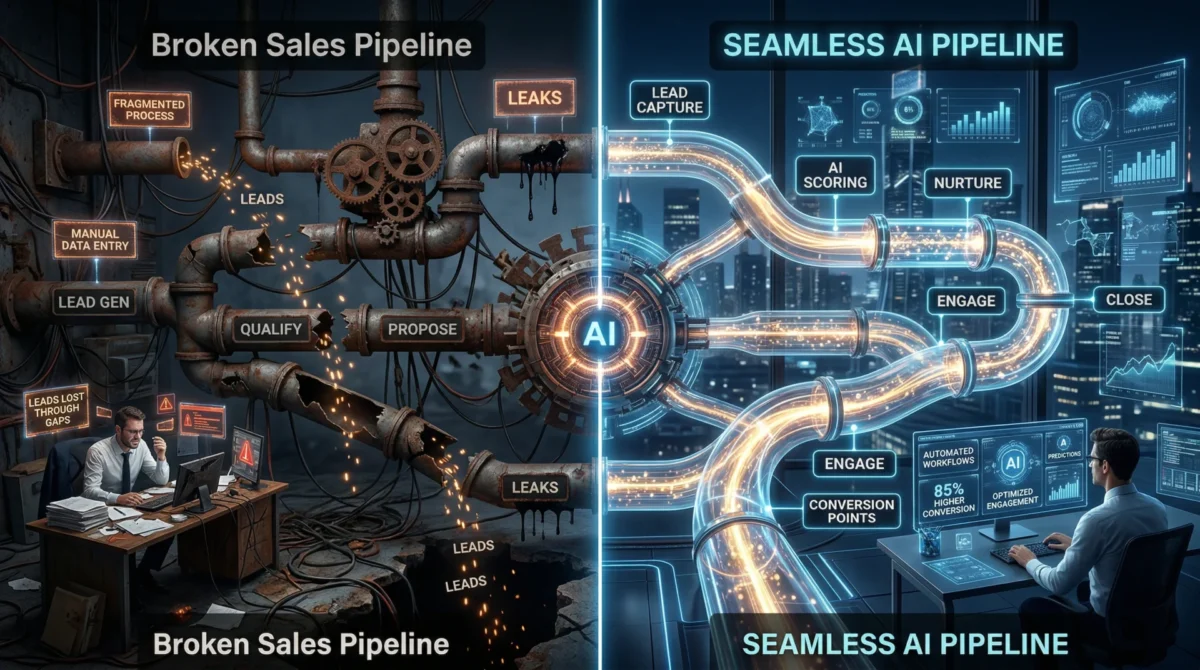
From manual tasks to executable flows
When flows like those in BIKY.ai are introduced, the process stops being a list of tasks and becomes a system that moves on its own.
Each event within the funnel triggers an action.
- A new lead starts a sequence.
- A message activates a follow up.
- A stage change updates information.
- Inactivity generates an automatic reminder.
This is consistent execution, where conversion stops depending on luck and depends on sales automation.
The role of AI: deciding what to do, not just executing
Traditional automation follows fixed rules, but commercial processes are dynamic. This is where emotional AI plays a critical role, almost human.
AI nodes within BIKY.ai can interpret what is happening in each interaction:
Detect intent
Understand context
Recommend the next action
This prevents flows from becoming rigid. The system does not just execute, it also decides how to move forward.
Impact on the team: less load, more focus
When processes are automated, the team’s work changes radically.
Before, much of the time was consumed by operational tasks.
Now, those tasks disappear from daily work.
The salesperson stops being a step executor and becomes someone who intervenes where real value is created:
- Negotiation
- Closing
- Customer relationships
It is important to clarify: BIKY.ai does not eliminate the human role, it frees it from tasks that waste time.
Live data: the end of the outdated CRM
One of the clearest symptoms of a non automated process is an incomplete CRM: duplicated data, outdated information and poorly recorded stages.
This does not happen due to carelessness. It happens because the system depends on manual input.
With automation, every interaction updates the system in real time. The CRM stops being an imperfect reflection of operations and becomes a reliable source of information.
This allows decisions to be made based on real data, not assumptions.
Real integration: connecting systems without friction
Another common problem is fragmentation. Tools that do not communicate, processes spread across platforms and teams working with different information.
BIKY.ai flows integrate systems through APIs and webhooks, allowing operations to flow without interruptions.
This not only improves efficiency, it also reduces errors and eliminates unnecessary dependencies.

Observability: knowing what is executed and what is not
One of the biggest risks of manual operations is lack of visibility. You do not know what was done, when or why.
With automated flows, every execution is recorded. Logs, alerts and metrics allow you to understand system behavior and detect failures quickly.
This introduces a new layer of control. Operations stop being invisible and become measurable.
Economic impact: consistency that translates into revenue
When a process executes correctly every time, results stop being variable.
- Lead loss is reduced
- Conversion improves
- Team time is optimized
- CAC is reduced
But the most important impact is predictability. The company stops depending on individual effort and starts operating with a reliable system.
Sales automation and alignment between teams
When the process is automated, marketing and sales stop operating in separate worlds.
- Data flows between both.
- Actions are connected.
- Decisions are based on the same information.
This eliminates internal friction and allows teams to work toward a shared goal: real results.
Why this shift will be inevitable
Operational complexity will continue to grow.
- More channels
- More interactions
- More data
Manual processes will not be able to sustain that level of demand.
Sales automation will stop being a competitive advantage and become a basic condition. Companies that do not adapt will be limited by their own structure.
The mistake many companies will keep making
They will keep looking for better salespeople and:
- They will invest in training.
- They will replace people.
- They will adjust incentives.
But they will not solve the core issue: a process that does not execute reliably.
And as long as that does not change, results will remain inconsistent. Sales automation is not just another tool. It is a shift in how commercial operations are built.
It is not about working more or demanding more from the team. It is about designing a process that works even when no one is watching.
BIKY.ai represents that approach, where flows execute automatically, data stays alive and the team can focus on what truly matters.
Because in the end, there are no bad salespeople, only processes that were never designed to be executed properly.