
Your Dealership Has Thousands of Data Points. But What Does It Really Know About Each Customer?
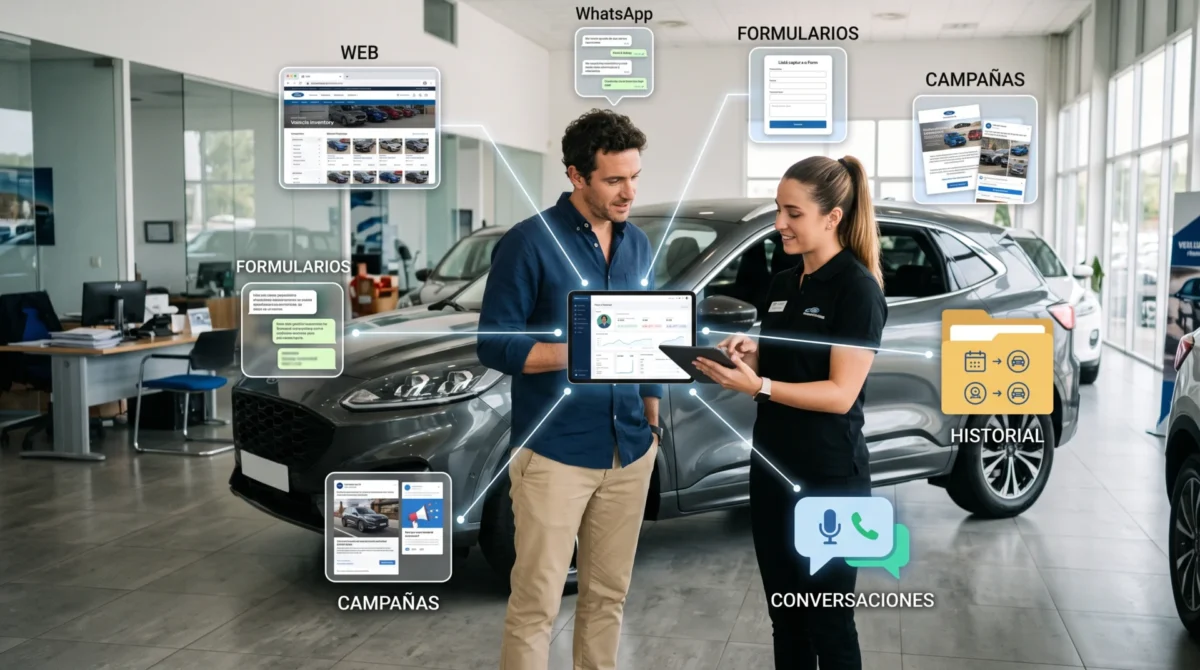
Every customer leaves signals before buying a vehicle. The problem is that these signals are often scattered across too many systems.
And when information is fragmented, so is the dealership’s view of its customer.
The Customer Does Not Change Their Story Just Because They Change Channels
Imagine a person who is looking to buy a vehicle.
- Sees an ad on Instagram.
- Visits the website.
- Reviews a model.
- Checks a promotion.
- Fills out a form.
- Then writes on WhatsApp to ask about financing.
Two days later, they visit the vehicle page again.
For the customer, all of this is part of the same experience.
For the dealership, it can mean six different records in six different places.
- Marketing knows which ad brought them in.
- The website knows which pages they visited.
- The CRM knows the lead.
- WhatsApp knows the conversation.
- The DMS may have information about their relationship with the dealership.
And the salesperson may have even more context in a conversation that was never recorded.
The problem, then, is not a lack of data.
The problem is that the dealership cannot always see the same customer as a single person.
That is where a CDP comes in.
When the Dealership Works with an Incomplete Version of the Customer
Without a CDP, each channel can keep its own history.
This creates very common situations in automotive sales.
A customer reaches out again and has to explain once more which vehicle they were looking for.
A salesperson does not know that the person had already spoken with another advisor.
Marketing targets someone again who is already in a sales conversation.
A lead appears duplicated because they provided their information at different times.
An opportunity goes cold and no one can identify exactly where the follow up broke down.
The company has information, but it does not necessarily have context.
And this comes at a cost.
- Efforts are duplicated.
- Time is lost.
- Intent signals are wasted.
- Friction increases for the customer, and the sales team ends up working harder to achieve the same result.
That is why the data problem is also a sales problem.
What Changes When a Dealership Connects Its Data?
In the case of BIKY.ai, the CDP unifies identity, activity, conversations, and events into a persistent profile. It also uses identity resolution to prevent duplicates and preserve context when a person changes channels.
This means the dealership can stop thinking:
“I have this lead in the CRM, this conversation on WhatsApp, and this activity on the website.”
And start thinking:
“I have a customer, and this is the entire history I have of their relationship with us.”
That change may seem simple.
But it transforms the way marketing, sales, and operations can work.

BIKY.ai’s CDP Works in Three Moves
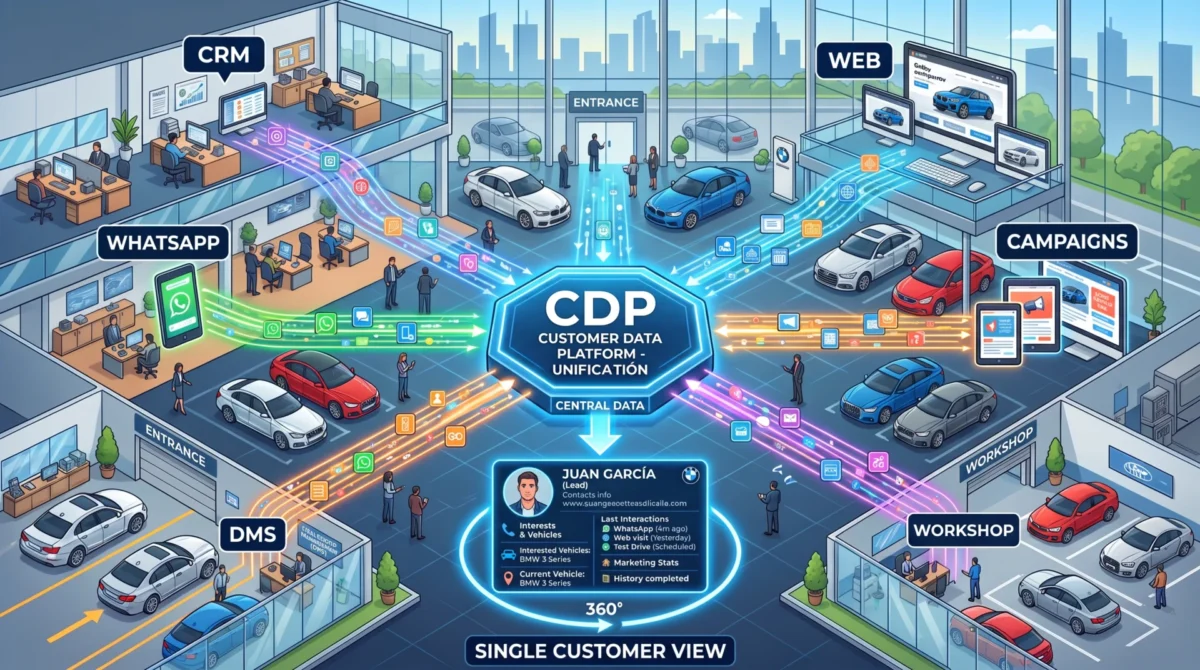
To make all this information useful, BIKY.ai approaches the CDP in three steps: connect, unify, and activate.
Connect: Bring Customer Signals Together
The CDP can connect sources and channels such as websites, forms, CRM, DMS, ERP, ads, chat, and QR codes, depending on the architecture of each operation.
The idea is not to replace all the systems the dealership already uses.
It is to make sure the information can contribute to a shared view of the customer.
Unify: Know Who the Customer Really Is
Then comes one of the most important points: identity.
If a person appears multiple times across different systems, the CDP must be able to recognize that they are the same customer.
BIKY.ai uses identity resolution and normalization to consolidate this information into a single profile.
This prevents duplicates and, above all, prevents the history from being lost.
Activate: Turn Context into Action
This is what differentiates a CDP designed for sales from a simple information repository.
The data can be used to create segments, activate follow ups, campaigns, reassignments, automations, and sales actions.
The goal is not to have a more complete customer profile.
It is to make sure that profile helps determine what to do next.
Intelligence Is Also in the Conversations
In automotive, an important part of customer intent does not appear in a table.
It appears in a conversation.
- “I’m comparing two models.”
- “How much would the payment be?”
- “Do you have it available?”
- “I want to trade in my current vehicle.”
- “I still haven’t made up my mind.”
These phrases contain sales information.
That is why BIKY.ai’s approach is not limited to structured data. Its CDP is designed to also work with conversational signals and turn that context into actionable sales intelligence.
This allows the operation to stop analyzing only what the customer did and also start considering what the customer said.
And that difference can be significant.
The CDP Does Not End with the Customer Profile
One of the most important ideas for understanding BIKY.ai is that the CDP does not operate as an isolated tool.
It is part of the BIKY method, which integrates other modules to turn customer data into concrete sales actions.
- SmartChat can use the profile to maintain conversations with greater context.
- Funnels can use identity and events to support the progress of an opportunity.
- Outbound can use segments and consent to activate contacts.
- Flows can execute automations using reliable data.
- Analytics can measure the operation and maintain traceability of what happens.
This creates a much more interesting cycle:
the customer generates signals → the CDP connects them → AI interprets the context → the operation executes → the result generates new data.
The system learns from what happens.
And this ability to learn is especially important in an industry where every interaction can influence the next one.
From Lead to the Complete Customer Relationship
Another key point for dealerships is that the relationship does not end with the sale.
A customer may go through financing, maintenance, after sales, renewal, and repurchase.
If each stage remains isolated, the company loses part of the value of that relationship.
With persistent identity and a historical timeline, the dealership can preserve the customer’s context throughout their lifecycle. BIKY.ai’s CDP specifically considers this lifecycle based reactivation logic, including after sales, repurchase, and renewal.
So the question is no longer simply:
“How do we get a new lead?”
It becomes:
“What can we do with everything we already know about this customer?”
This shift can have a significant impact on acquisition, conversion, and retention.
Quantitative Data to Measure. Qualitative Context to Understand
A sales operation needs metrics.
Conversions, response times, lead volume, opportunities, and sales remain essential.
But metrics alone do not always explain what happened.
A dealership may know that an opportunity did not convert.
The harder part is knowing why.
- Was there no follow up?
- Did the customer switch models?
- Did the financing not work out?
- Did the salesperson respond too late?
- Did the customer lose interest?
- Did the conversation reveal an objection that was never addressed?
A complete and traceable timeline makes it possible to get much closer to those answers.
That is why the CDP can also become a tool for coaching, quality control, and continuous improvement.
AI Needs Context to Be Truly Useful
This is perhaps the most important reason why a CDP becomes especially valuable when connected to artificial intelligence.
AI can respond very quickly.
But responding quickly does not mean responding well.
For an AI salesperson to act in a relevant way, it needs context: who the customer is, what they did, what they said, what stage they are in, what happened before, and what action should come next.
The CDP provides that foundation.
That is why intelligence is not only in the AI model.
It is also in the quality, continuity, and availability of the context it receives.
And this is where BIKY.ai’s architecture makes sense: the CDP is the layer that connects customer knowledge with the modules that execute the operation.
The Challenge Will Not Be Getting More Data
Dealerships will continue generating more information.
- More channels.
- More conversations.
- More campaigns.
- More digital interactions.
- More vehicle and customer data.
The challenge will be making sure that all this growth does not also increase fragmentation.
Because a company can have thousands of data points and still not really know what is happening with its customers.
A CDP changes that equation.
Not because it stores more information, but because it connects identity, conversations, events, and history to turn scattered data into context and context into action.
For a dealership, that means something very concrete: moving from working with isolated pieces of the customer to operating with a more complete view of their relationship with the brand.
In the end, the question is not how much data your dealership has.
The question is much more uncomfortable:
What does your dealership really know about each customer, and what is it doing with that knowledge?