
Smart Chat: Your chats already tell you who’s going to buy, you’re just not reading them carefully enough

Every day, conversations come in that look the same but are not. Inside those chats are already the buying signals, objections and urgency. The problem is not that they do not exist. The problem is that your operation still does not know how to read them.
Many companies still believe chats are just a support channel. Just another inbox. A place to answer questions quickly and move on to the next contact. That idea is outdated. In a market where attention lasts seconds and context defines conversion, Smart Chat is no longer support. It is real time commercial intelligence.
When a customer writes through WhatsApp, Instagram DM, Messenger or webchat, they are not just asking a question. They are leaving signals. They show intent, objections, urgency and tone. The issue is that most teams respond but do not interpret, and that is why sales are lost without anyone noticing.
That is why BIKY.ai is so relevant. Its Smart Chat does not just centralize conversations. It turns every interaction into an operational layer that detects data and buying signals, integrates that information into the CDP and CRM, and allows better prioritization of commercial attention.
The mistake: treating all chats as if they were the same
In most operations, chat is handled with a volume mindset. A message comes in, someone replies. Another comes in, someone replies. If there are many, they are distributed however possible. If there is no structure, responses depend on perceived urgency or intuition.
That model fails for a simple reason: not all chats have the same value. Some come from curiosity. Others from intent. Some ask about price because they are comparing. Others because they are one step away from buying.
If the operation cannot distinguish these nuances, it ends up assigning the same effort to conversations that do not deserve it and letting the important ones go cold.
The Smart Chat approach in BIKY.ai starts from this point. When chat is fragmented and lacks operational control, conversion is silently lost. Leads come through multiple channels, responses are delayed, context is missing and follow up depends on team habits. The result is abandonment, less trust and a funnel that does not reflect reality.
Smart Chat is not just an inbox, it is an operational layer
This is the difference that truly matters. A traditional chat centralizes messages. Smart Chat orchestrates operations.
BIKY.ai’s Smart Chat combines real omnichannel capability, team or campaign spaces, auto assignment, SLA, sentiment analysis, traceability, CSAT, metrics and multi agent functionality to turn conversation into execution.
This changes how chats are handled. It is no longer about replying fast. It is about responding with context, assigning with criteria, maintaining continuity and tracking every action. Chat stops being a messaging tool and becomes the system where a critical part of the sale happens.
For a commercial or operations leader, this has a clear economic implication. Speed alone does not solve the problem. If you respond quickly but assign incorrectly, without context and without follow up, you are just accelerating a poor experience. When intent is understood, urgency is prioritized and context is preserved, the conversation becomes an advantage.
Buying signals are already there, you just need to detect them
A customer who asks “how much does it cost?” is not always ready to buy. But a customer who asks “which one delivers faster?” or “can you send me the payment link?” is showing a different signal. A customer who comes back the next day after comparing options is not the same as one who arrives for the first time.
BIKY.ai’s advantage is that Smart Chat includes emotional AI that detects data and signals within the conversation and integrates them into the CDP and CRM. It also includes sentiment analysis to identify whether the tone is positive, neutral or negative, allowing prioritization with empathy and logic.
This goes beyond keyword detection. It is about interpreting commercial context.
A conversation may seem routine to a tired human at the end of the day, but AI can detect urgency, interest or friction patterns that are more valuable than they appear. When those patterns are recorded and integrated into operations, the organization stops reacting late.
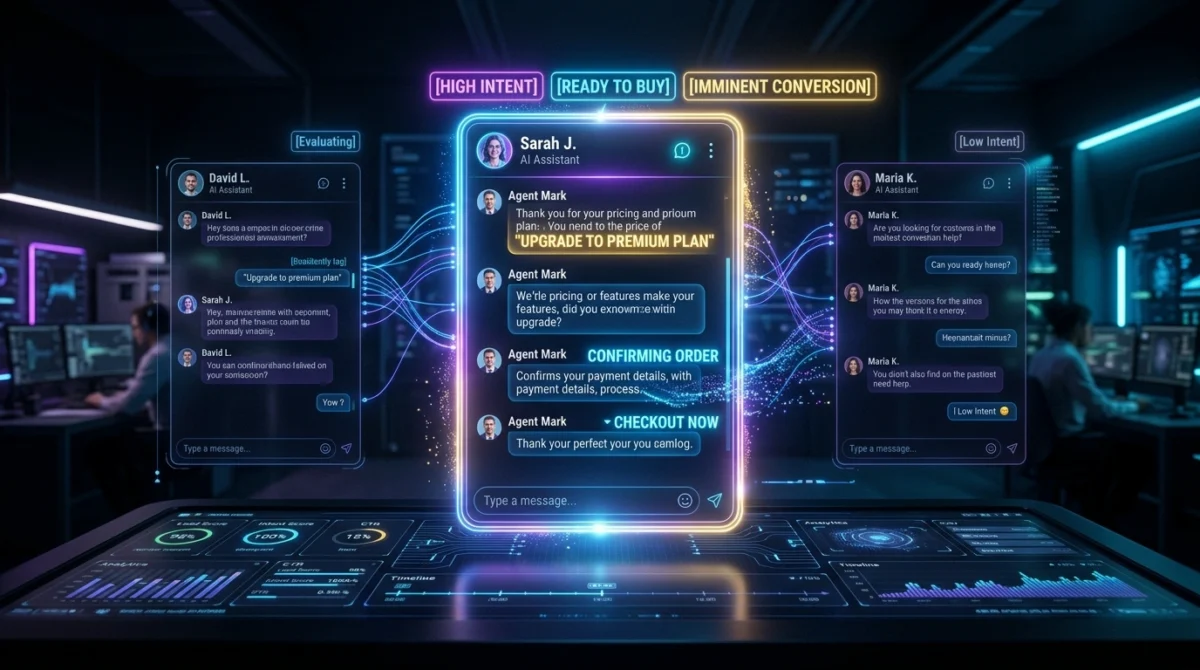
Emotional AI as the best ally for sales teams
Many teams still fear that AI will make customer relationships colder. The opposite is happening. When AI handles urgency, organizes context and detects intent, humans can focus on what they do best: decide, negotiate and close.
BIKY.ai presents Smart Chat as a hybrid operation. AI responds, qualifies intent and prioritizes urgency, while humans step in when commercial judgment, negotiation or closing is needed. It also provides handoff with summaries, intent and next steps, so the salesperson does not enter the conversation blindly.
This makes emotional AI the best ally for the team. Not because it replaces relationships, but because it prepares them. A salesperson with context can be more human, not less. They can respond precisely and avoid repetitive questions. They can address real objections instead of repeating scripts. In the attention economy, that matters.
The cost of not prioritizing correctly
When a company cannot read intent, everyone pays the price. Marketing feels leads are wasted. Sales feels they receive low value volume. Operations tries to organize something that was already disorganized.
This cost is not always visible in budgets, but it results in three clear impacts: higher abandonment, lower effective speed and poor use of human talent. It also leads to fragmentation, slow responses, orphaned chats, inconsistency and lack of control for auditing, training and scaling.
Simply put, when an operation cannot identify which conversations require immediate attention, it treats everything the same. In sales, treating everything the same is the most expensive way to prioritize incorrectly.
True omnichannel: context cannot reset with each channel
Another common issue is fragmentation. A customer starts on Instagram, moves to WhatsApp and later returns through webchat. In many companies, each channel starts from zero.
BIKY.ai’s Smart Chat unifies WhatsApp, TikTok, Facebook Messenger, Instagram DM and webchat into a single omnichannel inbox to maintain context and consistency. It also allows creating spaces by team, region, campaign or shift to ensure ownership and prevent orphaned conversations.
This directly impacts trust. When customers do not have to repeat themselves, they feel understood. When teams do not jump between channels, they sell with focus, and when organizations measure by channel, agent and response time, they move from intuition to process improvement.
SLA, auto assignment and follow up: discipline also sells
Many deals are lost not due to lack of effort but due to poor execution. Conversations are delayed, misassigned, not followed up or simply forgotten.
This is where Smart Chat’s operational layer becomes valuable. BIKY.ai includes SLA with response times, auto assignment, reminders, metrics and logs. It monitors performance by conversation and team to ensure discipline and reduce abandonment.
It distributes conversations based on availability, priority or skill, and sets reminders so follow ups do not go cold.
This may not sound exciting, but it is highly profitable. In sales, a large part of results comes from executing the basics well. The problem is that manual execution is rarely consistent.

Smart Chat also trains the business
One of the most powerful aspects of Smart Chat is that it not only helps sell in the moment but also creates learning for improvement.
BIKY.ai includes traceability, logs, CSAT, classification and operational metrics to measure performance by team, channel and response time, identify improvement areas and strengthen coaching and auditing. It also categorizes conversations to understand demand, contact reasons and patterns affecting conversion.
This introduces qualitative metrics that many companies lack. It is no longer just about counting chats or measuring time. It is about understanding why certain channels convert better, what tone creates friction, which objections repeat and which leads tend to go cold.
When an operation learns from its conversations, it stops improvising.
Human impact: less execution, more judgment
One of the key ideas behind BIKY.ai’s Smart Chat is this: the human stops capturing and chasing. They focus on judgment, relationships and closing.
This summarizes the value of a hybrid operation. AI does not remove meaningful work. It removes repetitive tasks and frees salespeople from constant chasing, allowing them to focus where they truly make a difference.
In terms of talent, this is significant. It improves efficiency and team experience. It reduces burnout, eliminates repetitive work and elevates the commercial role to where it should be: decision making, relationship building and closing.
What this means for commercial teams
We are closing a year where many companies have realized that responding to chats is not enough. Next year will not reward those who accumulate conversations. It will reward those who understand intent within those conversations.
Today, the combination of omnichannel, speed, context and prioritization will define who converts and who does not.
In this context, Smart Chat is no longer a support tool. It becomes a commercial infrastructure. BIKY.ai stands out because it does not just centralize chats. It turns buying signals into measurable operational execution.
That is exactly what teams need if they want to stop reacting and start leading with data.
Your chats are already telling you who is going to buy. They show it in tone, urgency, persistence, questions and even silence. The problem is not lack of information. The problem is that most operations still do not know how to read or use it in time.
Smart Chat changes that by turning conversation into a commercial operating system. That is where BIKY.ai creates value: detecting buying signals, integrating them into the CDP and CRM, prioritizing attention with criteria and freeing human teams to focus on what truly matters.