
AI in Physics That Could Help Uncover New Secrets of the Universe
What would happen if artificial intelligence helped scientists find clues that we still do not know how to interpret? A new partnership aims to explore that possibility.
For centuries, humanity has tried to understand the universe. We want to know what matter is made of and how it works. However, some questions remain unanswered.
Now, a collaboration between CERN and Mistral AI aims to expand the tools available to investigate these mysteries. The goal is to develop artificial intelligence specialized in particle physics. This technology could help analyze data and detect signals that deserve further investigation.
AI in Physics: A New Way to Explore the Invisible
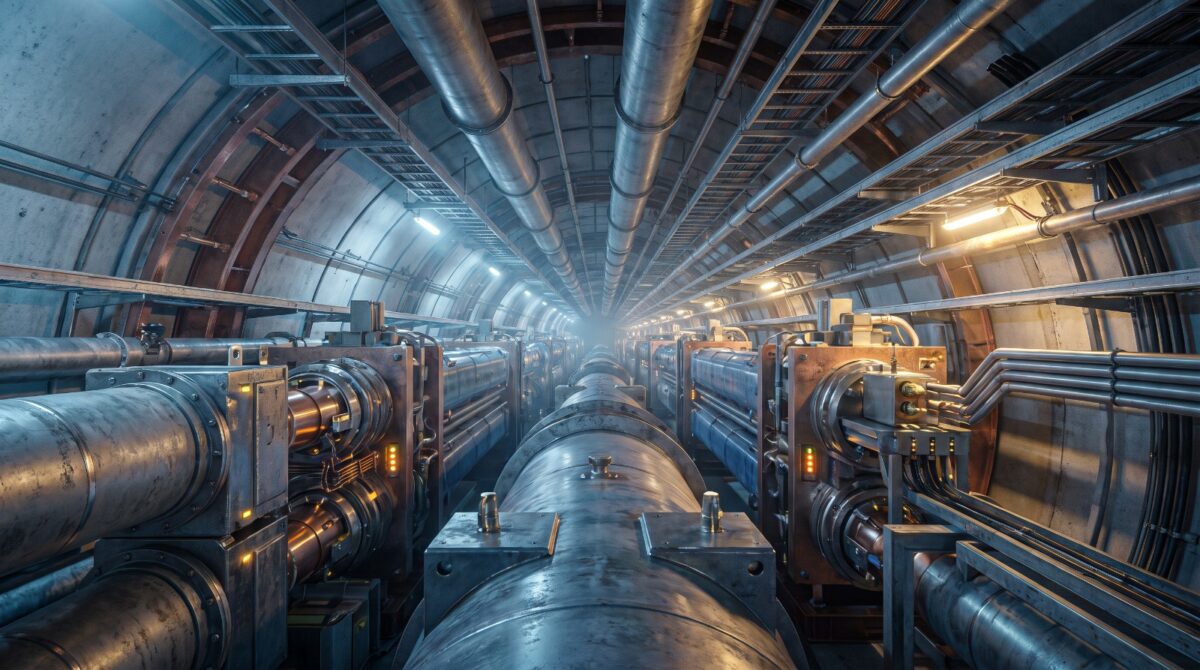
To understand this project, we first need to look at the work of CERN. It is home to the Large Hadron Collider, known as the LHC. It is the largest and most powerful particle accelerator in the world.
In its experiments, scientists make particles collide at extraordinary speeds. They then study the results to understand how matter behaves.
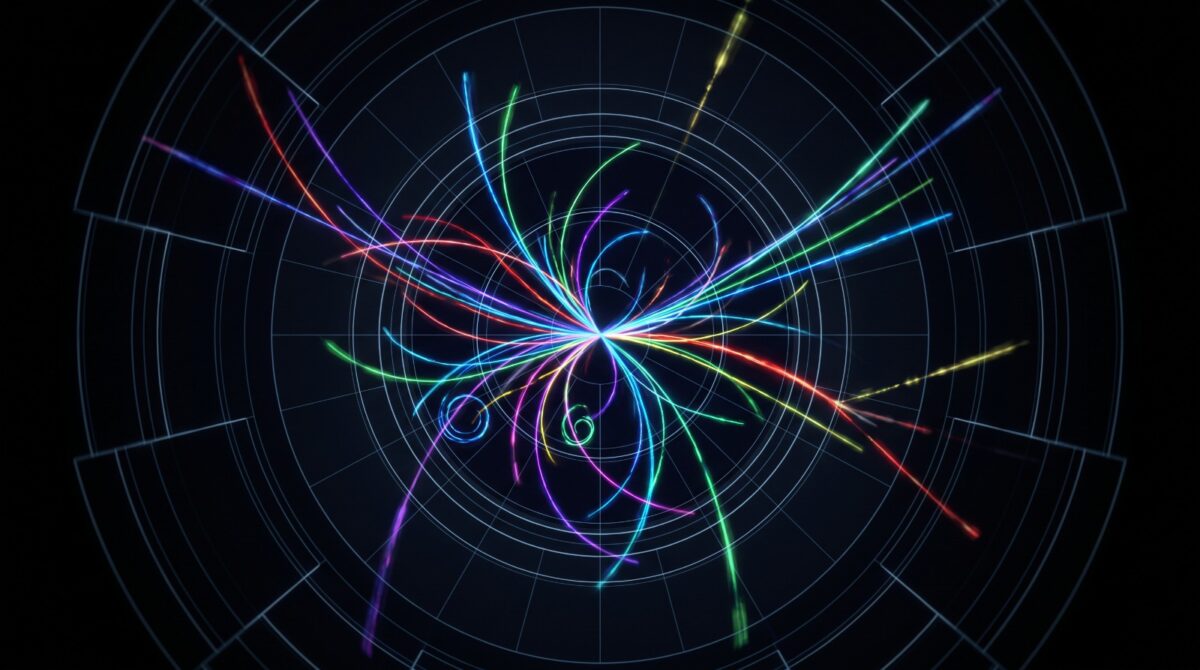
However, interpreting these results is not easy. Each collision can generate complex signals that detectors must record. Researchers need to reconstruct what happened and identify the particles involved.
They must also distinguish relevant patterns from enormous amounts of information. That is why AI in physics can become a useful tool for this work.
The project aims to develop a model capable of supporting several stages of the analysis. This would allow scientists to work with a tool that learns from different aspects of particle collisions.
Billions of Collisions to Train an AI Model
CERN announced its collaboration with Mistral AI on October 15, 2026. Both organizations signed a letter of intent to establish a long term strategic partnership.
One of its objectives is to develop a model specialized in particle physics. To train it, they will use billions of simulated proton collisions.
These simulations make it possible to study scientific scenarios and prepare tools for analyzing experiments. Through them, the model will aim to learn patterns related to particle collisions.
The scale of the data helps illustrate the magnitude of the challenge. According to CERN, the laboratory already stores nearly one exabyte of experimental data from the LHC. That amount is equivalent to approximately one million terabytes.
Furthermore, the volume of collisions is expected to increase tenfold with the accelerator’s future High Luminosity upgrade. It is scheduled to become operational around 2030.
With this growth, AI in physics could help process increasingly complex information. It could also reduce the need to combine different tools for each task.
What Could This Technology Discover?
One of the model’s objectives is to help reconstruct collisions and identify particles. It will also aim to detect unexpected signals that require further analysis.
This capability is particularly interesting because many scientific advances begin with an unexpected observation. Sometimes, a result does not match what researchers expected to find.
In such cases, detecting an anomaly can raise new questions. However, an unusual signal does not, by itself, prove the existence of a new particle.
Scientists must examine the data, test hypotheses, and verify the results. Artificial intelligence can help find clues, but it does not replace this process.
That is why AI in physics can expand research capabilities. Its value lies in helping scientific teams identify what deserves closer attention.
A Collaboration That Could Benefit Other Sciences
This partnership brings together two areas of expertise. CERN contributes its knowledge of fundamental physics, its data, and its computing infrastructure. Mistral AI brings its experience in developing artificial intelligence models.
The first objective is high energy physics. However, both organizations are also considering potential contributions to other scientific fields.
This opens up an interesting perspective. If new models make it possible to analyze complex data in a more integrated way, they could inspire tools for other research projects.
This does not mean that this technology will automatically lead to advances in medicine or the environment. Those applications would require specific development and validation.
Even so, the project shows how artificial intelligence can help investigate difficult scientific problems. It also demonstrates the importance of combining specialized knowledge with new analytical capabilities.
From BIKY.ai: What This Story Inspires Us to Consider
This collaboration reminds us that the value of artificial intelligence lies not only in processing information quickly. It also matters how it can help investigate questions that were previously difficult to address.
At CERN, every piece of data can contribute to an enormous puzzle. Finding relationships between those pieces can help researchers better understand the phenomena they study.
Technology can recognize patterns and analyze large volumes of information. However, people remain essential for asking questions, evaluating evidence, and interpreting results.
At BIKY.ai, this story invites us to reflect on an idea: artificial intelligence reaches its greatest potential when it expands human capabilities.
Its role does not have to be replacing people’s knowledge. It can also help them explore possibilities, make better decisions, and dedicate more time to tasks that require judgment.
The Universe Still Has Questions to Answer
The model being developed by CERN and Mistral AI is still an evolving project. The collaboration does not mean that new secrets of the universe have already been discovered.
However, it represents an interesting step in scientific research. The teams are seeking new ways to analyze data and study complex phenomena.
Perhaps some answers will come through future experiments. Others may emerge from identifying signals that previously went unnoticed.
The important thing is to maintain a balance between curiosity and rigor. Artificial intelligence can open up new possibilities, but every discovery needs evidence.
Because there is still much to understand about the universe. And every tool that helps us ask better questions can bring us a little closer to finding the answers.