
The CRM should record the sale, not prevent it

Many companies face a paradox: the system designed to improve sales ends up slowing them down. CRM, created to provide visibility and control, becomes an operational burden that consumes valuable sales time. The problem is not the concept of CRM. It is how it was designed for a reality that no longer exists.
Instead of providing visibility and control, it becomes an operational burden that consumes valuable selling time. The problem is not the CRM concept itself. It is how it was designed for a reality that no longer exists.
For decades, CRM was the symbol of commercial maturity. If the data was organized, the company had control. If the pipeline was documented, the operation was predictable.
But in the daily practice of many sales teams, CRM represents something very different:
- Endless forms
- Mandatory fields without context
- Constant manual updates
- Task duplication
The result is a structural tension: the more detailed the system, the less time remains to sell.
The problem is not technological. It is conceptual. Traditional CRMs were designed to record what happened, not to participate in operations in real time.
The cost of manual data entry
Few organizations calculate the true cost of the time invested in feeding the CRM.
The impact goes beyond operational minutes. It has strategic consequences:
- Reduced effective selling time
- Loss of commercial focus
- Incomplete or delayed information
- Team resistance to using the system
- Decisions based on unreliable data
A salesperson who spends two hours a day logging information is not selling. They are administering.
From an economic perspective, this represents a direct loss of productive capacity.
Before: CRM as a passive element
The traditional CRM model operates under a simple logic:
- A commercial interaction occurs
- The salesperson manually records what happened
- The system stores the information
This flow introduces several structural problems:
- Dependence on human behavior
- Risk of error or delay
- Low internal adoption
- Disconnection between conversation and record
The CRM observes the business. It does not execute it.
After: CRM as a sales operating system
The modern approach transforms CRM into an active layer within the commercial operation.
Instead of depending on manual entry:
- Conversations generate data automatically
- Actions are documented in real time
- The system updates the customer’s status
- Processes run without additional intervention
This is where BIKY.ai’s CRM introduces a structural shift: it eliminates the separation between interaction and record.
It doesn’t wait for data. It captures it.
What BIKY.ai’s CRM is and how it redefines sales management
It is a module within our sales platform designed to operate through conversations, automation, and intelligent execution.
Unlike traditional CRMs, its logic is reversed:
- First, the conversation happens
- The system interprets the interaction
- The record is generated automatically
- The funnel updates in real time
This allows CRM to stop being an additional task and become a natural consequence of the operation.
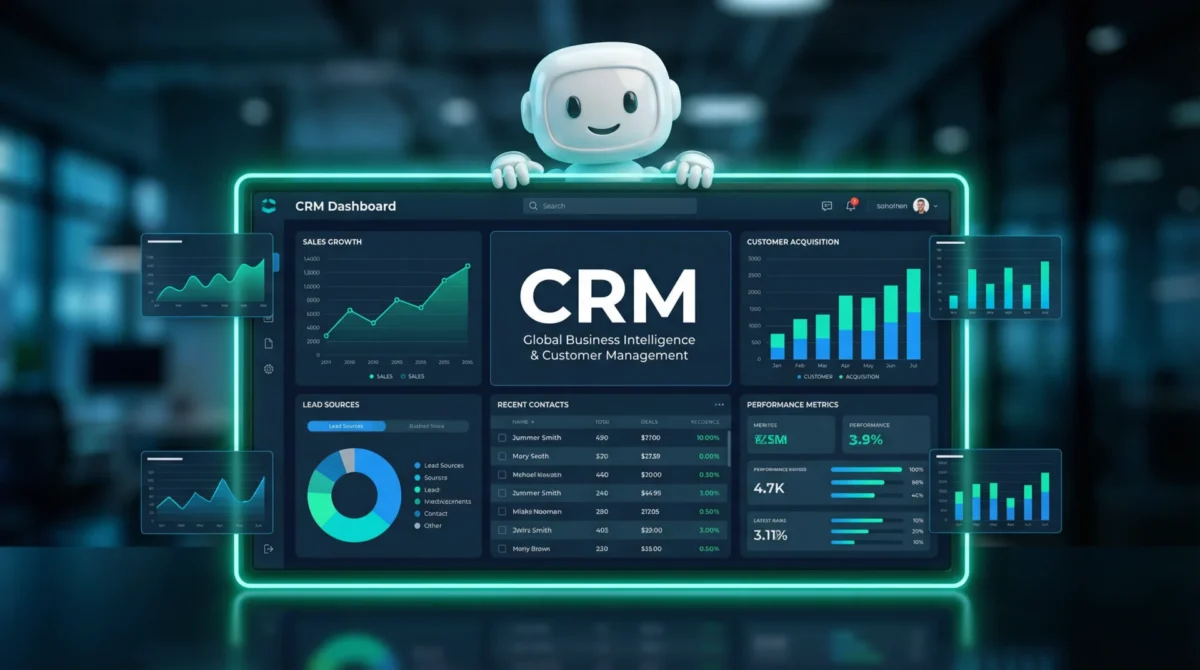
Conversation as a source of structured data
In the current sales model, most relevant information emerges from interactions:
- Chats
- Calls
- Messages
- Product inquiries
Traditional CRMs rely on someone manually translating that information.
In contrast, BIKY.ai’s CRM removes that intermediate step:
- Automatically logs interactions
- Structures data without human intervention
- Connects information to the pipeline
- Maintains full traceability
This reduces internal friction and improves data quality.
Commercial productivity: the real metric
The relevant question is not how many fields the CRM has. It is how much time it frees up for selling.
When logging is automatic:
- Real conversation time increases
- Follow-up continuity improves
- Administrative burden decreases
- The team stays focused on generating revenue
The attention economy applied to the sales team
The attention economy does not only affect customers. It also impacts salespeople.
Every administrative task competes with:
- Meeting preparation
- Opportunity follow-up
- Needs analysis
Reducing manual workload is not just about efficiency. It is about preserving human attention for strategic tasks.
BIKY.ai’s CRM addresses this need by automating repetitive processes and freeing cognitive capacity.
More reliable data, faster decisions
When logging depends on busy individuals, information is often:
- Incomplete
- Late
- Inconsistent
This directly affects:
- Forecasting
- Resource planning
- Strategic decisions
An automated CRM improves:
- Pipeline accuracy
- Operational visibility
- Analytics quality
Decision speed increases because the data reflects reality in real time.
Freeing humans from non-value-creating work
There is a simple premise in productivity: people should dedicate their time to what generates impact.
Manually recording data does not create direct value for the customer.
By removing that burden:
- The salesperson focuses on relationships
- The manager gains accurate information
- The organization scales without increasing complexity
Technology does not replace the team. It positions them where they create the most value.

The cultural shift behind automated CRM
Adopting an automated CRM implies a profound change in how the organization operates.
It means moving from:
- Manual control
- Intensive supervision
- Dependence on individual discipline
to a new level where there are:
- Intelligent processes
- Automatic execution
- Systems that sustain the operation
It is an organizational evolution, not just a technological one.
The true role of CRM in 2026
The CRM of the future will not be a database. It will be an execution system.
It must:
- Understand interactions
- Automatically record data
- Coordinate actions
- Provide immediate visibility
The objective is not to store information. It is to drive results.
Selling more starts by eliminating unnecessary work
Commercial transformation does not happen by adding more tools, but by eliminating operational friction.
BIKY.ai’s CRM demonstrates that data logging can be invisible, automatic, and a natural part of the sales process.
When the team stops feeding the system and the system starts working for the team:
- Productivity increases
- Information quality improves
- Commercial execution accelerates
- Human potential is unlocked
In a competitive environment, the advantage is not having more data, but obtaining it effortlessly and acting on it quickly.
CRM should no longer be a task. It should be a natural consequence of selling well.