
Your Website Should Not Just Show What You Sell. It Should Help You Sell It.
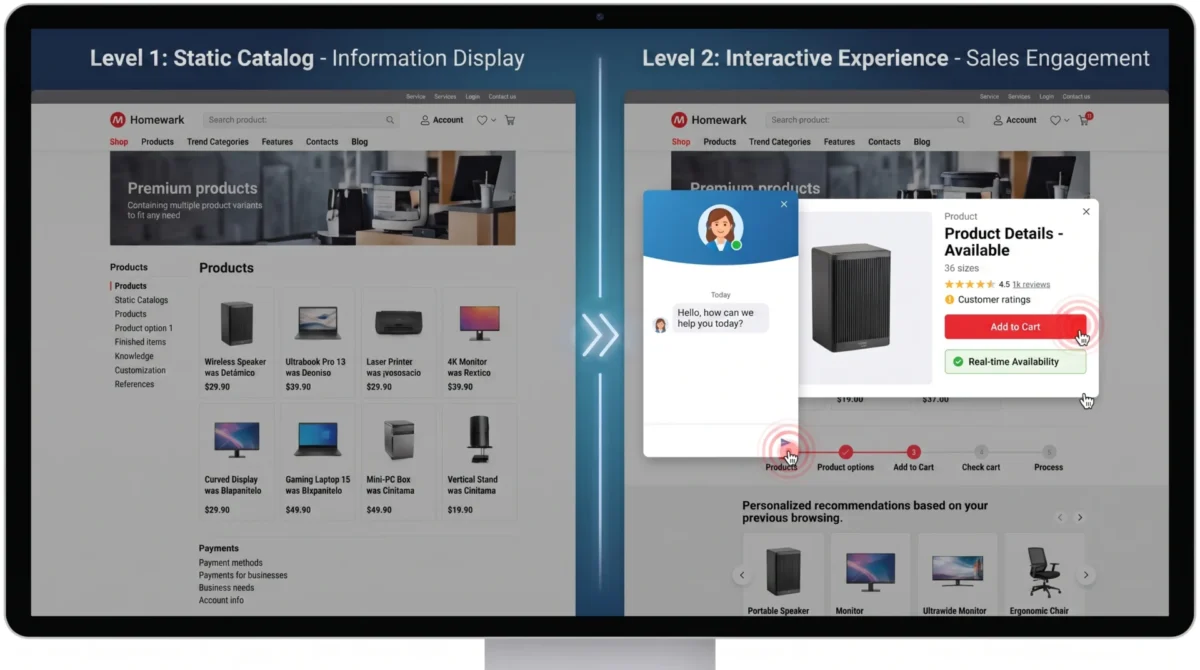
Traffic costs money. Attention does too. The question is what happens when someone finally reaches your website.
For years, companies built websites to show who they are, what they sell, and how to contact them.
It made sense.
But customer behavior changed.
Today, a person can research for days before speaking with a company. They can compare products, ask an AI tool questions, and arrive at a website with a much more specific need.
That is why conversational web raises a different question:
What if your website not only informs, but also helps people decide and move forward?
The Website Is No Longer Just a Showcase
A good website used to be measured by its design.
- That it loaded quickly.
- That it looked good.
- That it had good photographs.
- That it displayed products and contact information.
- All of that still matters.
However, it is no longer enough.
Google recognizes that people are asking longer and more specific questions in its new AI powered search experiences. It also points out that a good page experience means users can easily find the main information and navigate without friction.
This changes the role of the website.
The website is no longer simply the place where a brand presents itself.
It is also one of the places where the customer decides whether they want to continue.
And when that moment happens on a page that does not answer questions, does not provide clear information, or does not offer an obvious next step, the opportunity may disappear before sales has a chance to intervene.
The Problem Is Not Getting Traffic. It Is Losing It Afterwards.
A company can invest in advertising, positioning, social media, and content to bring people to its website.
But afterward, it may encounter an experience like this:
- The user arrives.
- Searches for a product.
- Cannot quickly find what they need.
- Opens a PDF.
- Compares information.
- Has a question.
- Looks for a way to contact the company.
- Completes a form.
- And waits.
The campaign generated the click.
The website received the user.
And yet, nothing happened.
This is where one of the most common contradictions in digital operations appears: marketing works to capture attention, while the website is often designed simply to receive it.
The consequence is economic.
Every visit that does not find a next step represents an opportunity that can be lost.
Marketing captures attention. The website needs to know what to do with it.
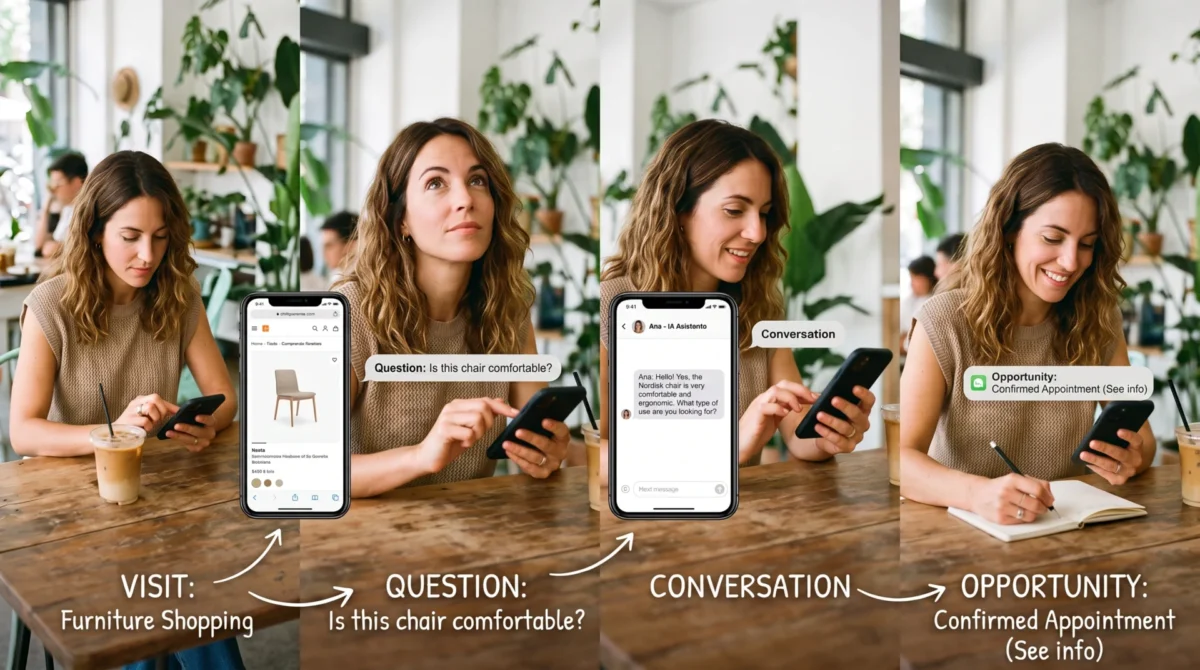
The Customer Does Not Want to Browse. They Want to Move Forward.
This difference may seem small, but it completely changes how a website should be built.
Imagine someone looking for a vehicle.
They may want to know the price.
- Or compare two versions.
- Find out about availability.
- Understand a financing option.
- Confirm whether specific equipment is included.
On a traditional website, they will probably have to search for this information across different pages.
A conversational website can offer a different experience.
The information is still available, but there is also a layer capable of interpreting what the person needs and helping them move forward.
It is not about filling the website with technology.
It is about reducing friction.
And the change is already happening in digital behavior. A 2025 study published by Clutch found that 83% of surveyed consumers had used AI tools on websites during the previous six months, including AI search and conversational tools. (Clutch)
Technology is becoming part of the expectation.
But that does not mean that every chat improves the experience.
A Conversational Website Is More Than a Chat
Here is an important distinction.
Adding a conversation window to a traditional website does not automatically turn the site into a sales channel.
If the information is disorganized, the catalog is incomplete, or the customer cannot understand the alternatives, the problem remains.
That is why a conversational website needs to connect different layers:
Content → information → conversation → action.
First, structured content so that search engines and generative engines can understand the offering.
Then, specific information to help people make a decision.
Next, conversation to resolve questions and understand intent.
Finally, a clear action: buy, schedule, call, write, register, or continue the process.
The website needs to be understandable both to the customer and to the machines that help that customer find it.
This is where SEO and GEO meet.
From Informational Website to Sales Channel
This is where SITE by BIKY.ai makes sense.
SITE turns the website into a conversational point of sale.
It does not simply create pages.
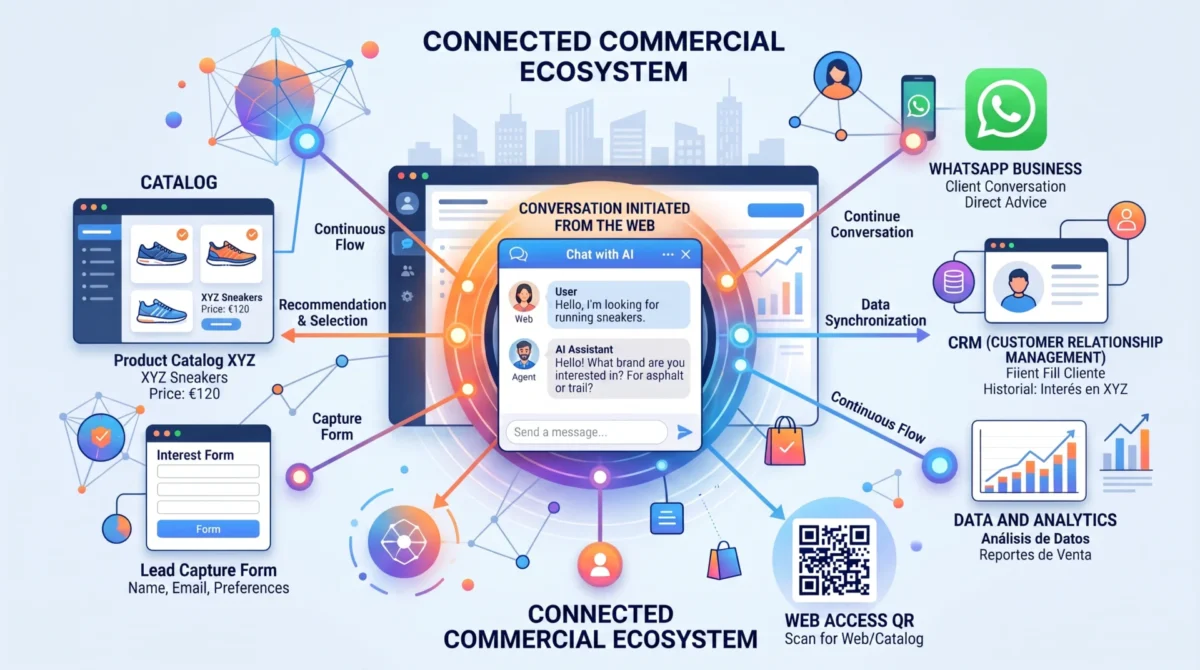
It integrates structured content for SEO and GEO, actionable catalogs, action buttons, forms, QR codes, and an embedded chat avatar capable of handling, qualifying, and guiding conversations.
The idea is simple:
A visit should not necessarily end with a page view.
It can become:
- identity.
- intent.
- conversation.
- next action.
And when a real opportunity exists, it can continue within the sales operation.
The Catalog Also Needs to Change
For years, many companies have treated the catalog as a file.
- A PDF.
- An image.
- A table.
- A product listing.
But when customers need to compare, ask questions, or make a decision, this format begins to fall short.
SITE proposes a conversational catalog, with product cards that organize attributes, variants, bundles, and comparable products so that the information becomes more useful during the decision making process.
This is especially relevant in industries with complex products.
In automotive, for example, a person does not always ask:
“What vehicles do you have?”
They may ask:
“Which one would be right for me if I need space for my family but do not want to go over a certain budget?”
The difference is that the second question contains intent.
A Website Designed to Sell Needs to Be Able to Work With That Intent
Every interaction should leave something more than a click.
Here is another important difference.
- A traditional form captures data.
- A QR code captures a registration.
- A button generates an action.
But in isolation, these elements say very little.
The real value appears when the information is connected.
SITE allows forms and QR codes to be used to register contacts from campaigns, events, stores, or physical locations, preserving their source and purpose to activate conversation and follow up.
This way, a QR code at a dealership can become the beginning of a conversation.
A campaign landing page can become an opportunity.
A visit to a product can provide information about intent.
The contact stops being an isolated piece of data and begins to become part of the sales journey.
The Website Also Needs to Understand What Happened Afterwards
One of the major weaknesses of many digital operations is the lack of continuity.
- Marketing knows how many people arrived.
- Sales receives some leads.
- Operations observes the final results.
But between these points, there can be a huge gray area.
- Who asked?
- What product were they interested in?
- Which campaign did they come from?
- What conversation did they have?
- What next step did they receive?
- Was follow up completed?
- Did it become an opportunity?
- Did it result in a closed sale?
SITE connects pages, catalogs, buttons, forms, QR codes, and conversations with CDP and CRM to build traceability from campaign → visit → conversation → opportunity → close.
This changes the role of the website.
It stops being simply a marketing asset and begins to become information for the sales operation.
AI Does Not Have to Replace the Salesperson
And here it is worth avoiding an overly simple conclusion.
The goal is not for the customer to never speak with a person.
On the contrary.
BIKY.ai AI salespeople can maintain active conversations, understand context, provide information, qualify, and guide customers toward the next step even when a human salesperson is unavailable.
When the moment comes when human judgment adds more value, the salesperson can intervene with context.
This makes it possible to distribute the work more effectively.
AI can maintain continuity.
The human team can focus on conversations where their experience, negotiation, and judgment truly matter.
Technology does not have to take humanity out of sales. It can take friction out of it.
The Next Website Will Not Just Be More Beautiful. It Will Be More Useful.
A company should no longer think of its website as the place it sends traffic to.
It should think of it as the place where that traffic begins to turn into intent.
- Because a visit without an answer can be lost.
- A catalog without context can create confusion.
- A form without follow up can become just another lead.
- And a conversation without traceability can disappear inside an inbox.
Conversational web changes this logic.
Content to be found.
Information to decide.
Conversation to move forward.
Data to measure.
That is what SITE by BIKY.ai proposes: turning the website into a sales channel connected to the operation, where every visit has the possibility of finding an answer and a next step.
The website is no longer a showcase. It can now be part of the sale.