
The Problem Is Not Having Multiple Channels: It Is Losing Context Between Them
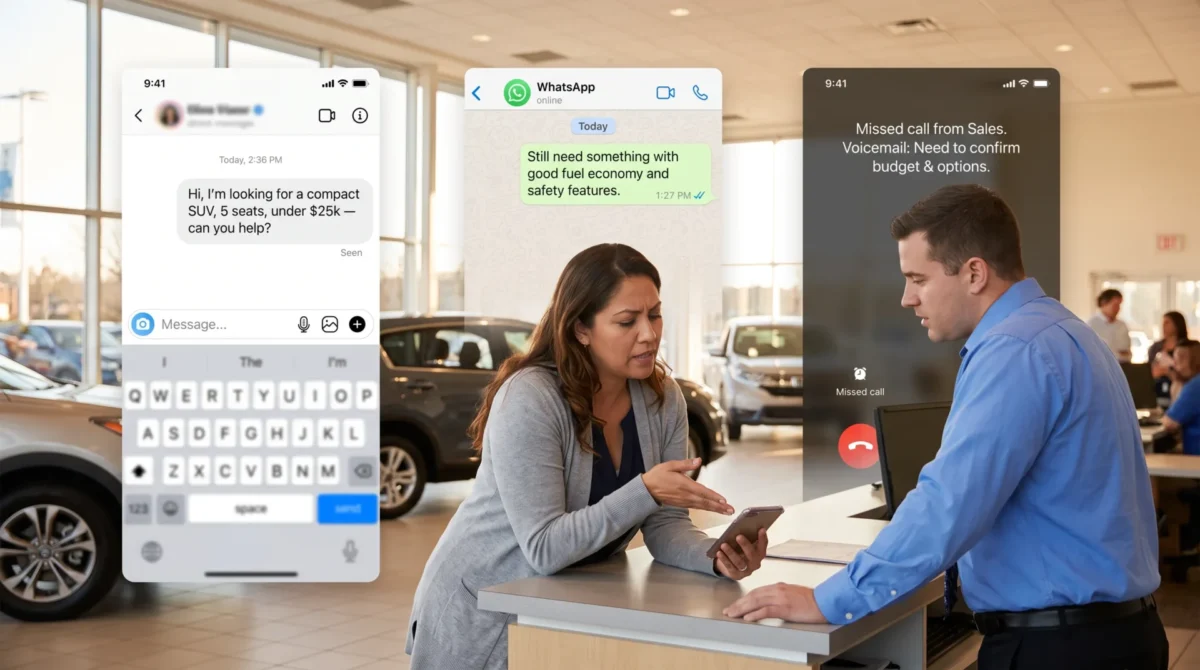
Having more channels does not mean knowing the customer better. The key is to maintain context across channels to understand what happened before each conversation and provide a connected experience.
For years, companies have understood omnichannel presence as a matter of being available: on WhatsApp, social media, websites, email, and other touchpoints.
However, there is a contradiction.
A company can be available across all channels and, at the same time, deliver a completely fragmented experience.
The customer asks a question on Instagram, continues on WhatsApp, and ends up speaking with a salesperson. But in every conversation, they have to explain again who they are, what they are looking for, and what they discussed before.
The problem is not the channels.
The problem is losing context across channels.
Channel Fragmentation Comes at a Commercial Cost
Imagine a customer interested in buying a vehicle.
- First, they see an ad and ask a question on WhatsApp.
- Then, they visit the website and leave their contact information.
- Hours later, they receive a call from a salesperson.
For the company, these were three interactions.
For the customer, it was a single conversation.
This is where a fundamental difference emerges.
When systems operate in isolation, each channel builds its own version of the story. Marketing sees the ad. The CRM sees the lead. WhatsApp sees the messages. The salesperson sees only what is available to them at that moment.
But no one necessarily sees the complete journey.
And when context is lost, information that could be decisive in making a sale is lost as well.
Customers Should Not Have to Repeat Their Story
One of the biggest hidden costs of a fragmented operation is repetition.
- “Which vehicle were you looking for?”
- “Had they already sent you the quote?”
- “Who did you speak with?”
- “Which model had you looked at?”
- “What was your budget?”
Each question may seem minor.
But together, they create friction.
- The customer feels that every conversation starts from scratch.
- The salesperson loses time reconstructing information.
- Marketing loses visibility into what actually happens after the lead arrives.
And management loses something even more important: the ability to understand the complete journey that generates a sale.
That is why an omnichannel experience is not simply about connecting channels.
It is about maintaining a single story across all of them.
Context Is a Commercial Asset
In a traditional operation, data is usually stored as records.
- Name.
- Phone number.
- Model of interest.
- Lead source.
- Contact date.
But context goes far beyond these fields.
It also includes what the customer asked, the objections they raised, what they ruled out, the tone of the conversation, their preferences, and the actions they took previously.
This is where a CDP becomes relevant.
A Customer Data Platform should not be understood simply as another place to store information. Its true value emerges when it makes it possible to build a unified view of the customer using data that was previously scattered across separate systems.
The goal is not to accumulate data.
It is to build usable context.

From Isolated Data to a Complete Story
Let’s think again about the automotive customer.
- The ad shows them a model.
- The conversation reveals that they are looking for financing.
- Then they ask about availability.
- Later, they schedule an appointment.
- Finally, they visit the dealership.
Each of these events has value on its own.
But together, they tell a story.
If the company connects these events, it can better understand the customer’s intent and decide what should happen next.
If it does not connect them, each area works with a different snapshot.
Marketing may think it generated a good lead.
Sales may think the customer is undecided.
Operations may not know that an appointment exists.
And management may see only the final outcome.
Connecting this data makes it possible to understand the customer’s complete journey and make better commercial decisions.
The CRM Records. The CDP Connects.
This difference is important.
The CRM serves a fundamental purpose: managing relationships, opportunities, activities, and sales processes.
But when customer information is distributed across multiple sources, we need a layer capable of connecting it.
For example:
Advertising → conversation → identity → intent → vehicle → quote → appointment → close → after sales.
When these elements are connected, the company can move from managing records to understanding behavior.
This changes the questions it can answer.
It is no longer just about knowing how many leads came in.
We can also ask:
- Which campaign generated conversations with stronger intent?
- At what point was interest lost?
- Which objections arise before an appointment?
- What information does a salesperson need before stepping in?
- What happens after a conversation?
The difference may seem technical.
In reality, it is strategic.
Fragmentation Also Affects Marketing and Sales
The problem of context does not belong exclusively to the sales department.
It also affects the relationship between Marketing and Sales.
Marketing may optimize campaigns based on the number of leads.
Sales may evaluate those leads based on conversations and closed deals.
If both teams work with different data, each ends up optimizing a different part of the system.
Marketing seeks to generate more.
Sales seeks to convert better.
But the company needs to answer a common question:
What type of interaction actually generates commercial value?
To answer this, the customer’s source must be connected to what happened afterward.
That is why the most important data point is not always the first click.
It may be the complete sequence.
The attention economy requires a more precise understanding of this journey.
Every interaction competes with many others.
If the company loses information between one contact and the next, it also loses the ability to respond to the intent it has already developed.
A Salesperson Should Not Have to Reconstruct Context Manually
There is another, less visible problem.
When systems are disconnected, the salesperson becomes a data integrator.
- Reviews WhatsApp.
- Searches for the record in the CRM.
- Asks Marketing.
- Reviews a quote.
- Checks availability.
- Searches for a previous conversation.
And finally, they try to reconstruct what the customer wants.
This work consumes time and increases the possibility of errors.
It also creates a dangerous dependency: customer knowledge remains in one person’s memory instead of being preserved within the system.
Technology should work the other way around.
The system should provide context so that the salesperson can make better decisions.
It should not force them to become an investigator.

The Non Fragmentation Rule
This idea connects directly with one of the principles of the BIKY Method: the Non Fragmentation Rule.
Its logic is simple: an interaction should not become an isolated story.
Every conversation must form part of the customer’s living record and inform subsequent actions.
That is why the BIKY Method proposes a sequence in which every interaction can become data, data can become intelligence, intelligence can become action, and action can lead to measurement and continuous improvement.
Technology stops being a collection of independent tools and begins to function as a system.
And this is where the CDP stops being merely a data infrastructure layer.
It becomes part of the sales operation.
True Omnichannel Begins When Customers Stop Noticing the Channels
A truly connected experience has an interesting characteristic: customers should not have to worry about which system the company is using.
- They can start on Instagram.
- Continue on WhatsApp.
- Speak with an AI Salesperson.
- Move to a human salesperson.
- Receive a quote.
- Schedule an appointment.
- And get in touch again days later.
What matters is that the story continues.
The channel can change.
The context cannot.
This is probably one of the most important differences between being present across multiple channels and building a truly omnichannel operation.
The Next Level Is Not Adding Another Channel
Companies will continue incorporating new touchpoints.
New platforms, new formats, and new ways of communicating with customers will emerge.
But the strategic challenge will not be being everywhere.
It will be ensuring that all this activity produces a coherent view of the customer.
Because the more channels there are, the greater the risk of fragmentation if information is not connected.
That is why, before asking, “Which channel are we missing?”, sales management should ask:
Can we follow a customer’s complete story, regardless of where the conversation began?
If the answer is no, the problem is probably not the lack of another channel.
It is the lack of context.
The Future of Sales Will Not Be Multichannel. It Will Be Contextual.
The competitive advantage will not simply lie in responding through more channels.
It will lie in responding better because the company understands what happened before.
This means connecting data, conversations, intent, operations, and results.
It also means changing how performance is measured.
It is not enough to know which channel generated a lead.
We need to understand what happened afterward.
Because an isolated conversation is a data point.
But a conversation connected to the customer’s entire journey is commercial intelligence.
And that difference can determine how quickly an organization learns from every interaction.
Before Adding Another Channel, Connect the Story
Commercial transformation does not always require more tools.
Sometimes, it requires existing tools to start sharing context.
That is the real challenge of omnichannel: not getting a company to be present in more places, but ensuring that it can remember, understand, and act on what the customer has already said, regardless of where they said it.
Discover the BIKY Method
The BIKY Method develops a model for connecting data, conversations, sales execution, measurement, and continuous improvement within a single operation.
If you want to explore how to move from a fragmented operation to a connected sales system, you can download the complete method and review it with your team.