
Automating sales doesn’t kill opportunities: it eliminates the noise that ruins them

For years, automating sales processes felt like a silent threat: less human involvement, more coldness, weaker relationships. But in practice, what damages the customer experience the most is not automation. It is disorganization, delays, and inconsistent follow-up. The good news is that today you can automate sales with AI in a way that speeds up commercial processes without sacrificing human connection.
Many sales teams still defend manual processes in the name of closeness. They believe every message must be sent by hand, every follow-up must rely on the salesperson’s memory, and every customer step must be managed in an artisanal way.
The result is usually the opposite of what they expect:
- Late responses
- Unintentional forgetfulness
- Inconsistent follow-up
- Customers who feel ignored
In an environment dominated by the attention economy, slow responses are not perceived as “human.” They are perceived as lack of interest.
Automation does not eliminate opportunities. It eliminates the noise that interrupts them.
What automating sales with AI really means
Automating sales is not about replacing people with rigid bots. It is about designing systems that execute repetitive tasks, coordinate processes, and maintain the pace of the commercial conversation.
It means that:
- Follow-ups are triggered automatically
- Information is logged without manual effort
- Basic responses do not depend on human availability
- The funnel advances based on real behavior
AI does not take control of the relationship. It makes sure nothing important is lost due to oversight.
Before (manual process):
A lead arrives. The salesperson responds when they can. If the customer does not reply, follow-up depends on memory or individual discipline. The CRM is updated late. Opportunities cool off.
After (AI-powered automated process):
The lead receives an immediate response. If they do not reply, a follow-up flow is activated. Actions are logged automatically. The salesperson steps in when the conversation requires human judgment.
The difference is significant: response rates, consistency, and customer experience all change.
BIKY.ai Flows: no-code AI automation for sales teams
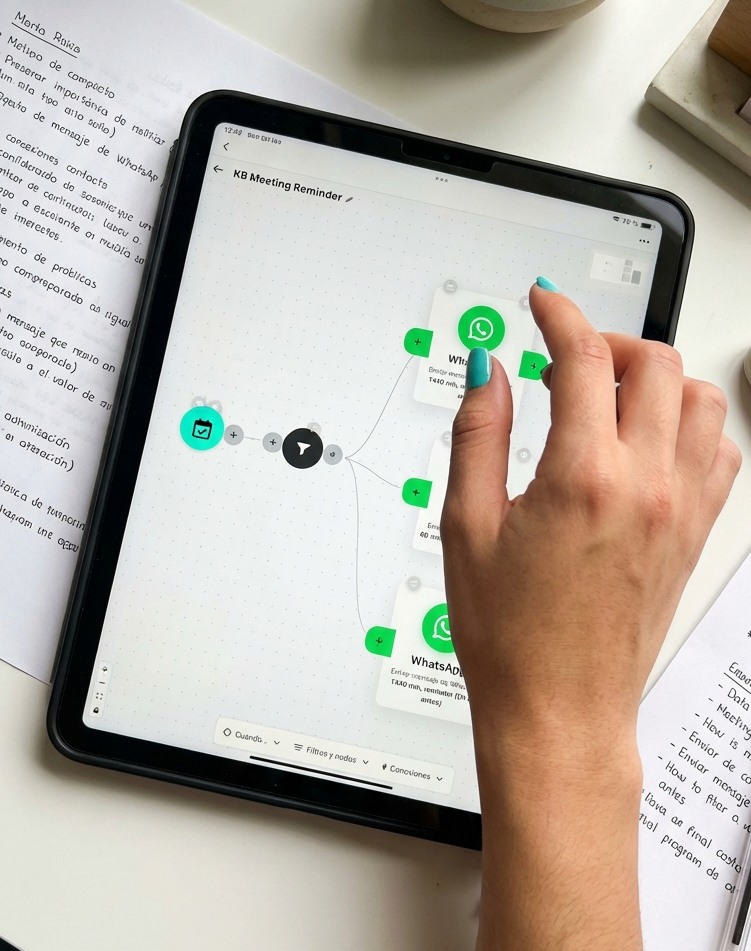
The Flows module of BIKY.ai is designed to solve one of the biggest automation bottlenecks: technical dependency.
BIKY.ai allows non-technical teams to create flows that:
- Send automated messages
- Log data into the CRM
- Coordinate actions across channels
- Trigger internal tasks
- Escalate conversations when needed
This means automation stops being an IT project and becomes an operational sales tool.
Flows do not replace the salesperson. They ensure every opportunity receives timely attention.
Automation as a guarantee of consistency
One of the biggest risks in sales is human variability. Not because of lack of skill, but because of workload.
When everything depends on people:
- Some leads receive excellent follow-up
- Others are forgotten
- The experience becomes uneven
Automation brings consistency:
- Everyone receives a response
- Timelines are standardized
- Follow-up does not depend on mood or calendar availability
From an economic perspective, this reduces invisible losses and improves CAC efficiency.
More automation means more room for high-value conversations
Paradoxically, when automation is done well, human contact improves.
By freeing the team from:
- Repetitive tasks
- Basic messaging
- Manual data entry
Salespeople can focus on:
- Understanding complex needs
- Negotiating
- Building trust
- Closing deals
Automation does not remove the human element. It gives time back so people can truly be human.
The attention economy: speed as a form of respect
Today, responding quickly is not just efficiency. It is a signal of interest.
When a company responds immediately:
- The customer feels valued
- The conversation keeps momentum
- The probability of conversion increases
The automated flows of BIKY.ai ensure that this first response does not depend on someone being available. Speed stops being accidental and becomes part of the operational design.
Metrics that improve when automation is strategic
Well-implemented automation directly impacts critical metrics:
- Time to first response
- Effective contact rate
- Stage progression
- Reduction in lost leads
- Operational load per salesperson
The goal is not to automate because it is fashionable, but to automate where economic impact is highest: speed, consistency, and continuity of experience.
The myth of coldness and the reality of experience
What customers perceive as “cold” is not automation. It is disorganization.
Waiting days for a response, repeating information multiple times, or not knowing the status of their process creates more distance than any automated flow.
When automation is well designed:
- Customers receive timely attention
- The experience is smooth
- The conversation feels continuous
That builds trust, not distance.
Automating is designing a more human experience
Automating sales with AI is not dehumanizing. It is removing everything from the commercial experience that distracts, delays, and exhausts.
The flows of BIKY.ai show that well-applied automation:
- Improves consistency
- Accelerates response
- Frees the human team
- Increases relationship quality
In a world where attention is limited, the company that responds better, faster, and with coherence is not the one with the most people manually typing messages. It is the one that designed its operation so nothing important is ever left unattended.
Automation, when done right, does not cool down sales. It makes them possible at scale without losing closeness.