
If you don’t understand your conversion rate, your business isn’t ready to scale

Many businesses believe they are growing because they are generating more leads, but if they don’t understand their conversion rate or why some customers buy while others drop off, they’re just adding to the operational noise.
There is an obsession in many companies with generating volume.
- More campaigns.
- More clicks.
- More chats.
- More forms.
However, very few organizations truly understand their conversion rate, and even fewer understand which conversations, channels, or behaviors are generating real revenue.
This is where one of the biggest challenges of modern growth appears: measuring activity instead of measuring intent.
Because a company can have hundreds of leads every day and still lose money. It can have busy teams and full pipelines while operating completely blind.
That is why analytics has stopped being a pretty dashboard. Today, understanding your conversion rate means understanding whether your operation can truly scale or if it is simply surviving on artificial volume.
Most Companies Do Not Really Know Why They Sell
This is an uncomfortable reality. Many companies know their numbers at a superficial level, but they do not understand the causality behind them.
They know how many leads come in, but they do not know:
- Which ones have real intent
- Which channel converts best
- Which objections stop deals from closing
- Which salespeople cool down opportunities
- Which part of the process destroys commercial momentum
And when a company does not understand that, its growth depends on intuition.
The problem is that intuition works only up to a certain point because after a certain volume of information, it becomes dangerous.
Conversion Rate Is More Important Than Lead Volume
Many teams celebrate metrics that do not necessarily represent real growth.
- More chats do not always mean more sales.
- More forms do not always mean more opportunities.
- More traffic does not always mean more revenue.
The conversion rate reveals something much more important: operational efficiency.
Because it shows:
- How well the system converts
- How clear the value proposition is
- How quickly the team responds
- How aligned marketing and sales are
This is where BIKY.ai changes traditional analytics because it does not just display numbers. It connects conversation, intent, and commercial outcomes.
The Real Problem Is That Most Companies Measure Incomplete Data
Many companies still work with isolated metrics.
- Marketing measures CPL.
- Sales measures closed deals.
- Operations measures response times.
And nobody manages to close the complete loop.
The result is silent chaos. That is why end-to-end traceability is becoming so important.
Because it is not enough to know how many leads arrived.
You need to understand:
- Where they came from
- What they said
- What intent they had
- Who handled them
- How long the process took
- Which objections appeared
- Why they ended up buying or abandoning
Unstructured Data Is Where Commercial Truth Lives
Something interesting happens here. Traditional metrics usually ignore the most valuable information: what conversations actually say.
That is where you find:
- Real doubts
- Emotions
- Urgency
- Objections
- Genuine interest
- Reasons for loss
However, most tools only analyze cold numbers. Instead, BIKY.ai incorporates conversational intelligence precisely to solve that gap.
With BIKY.ai metrics, it is possible to analyze:
- Intent
- Sentiment
- Objections
- Tone
- Urgency
- Conversational behavior
This transforms the quality of decision-making because you no longer optimize only for quantitative metrics. You begin to understand the human context behind conversion.

Appointment Rate Reveals Whether Your Operation Actually Works
Many companies obsess over closing sales but ignore a critical metric: appointment rate.
And that is a huge mistake because before a deal closes, there is a more important step: achieving real commitment.
- A meeting.
- A call.
- A demo.
- A visit.
When appointment rates drop, the problem is usually not the product. It is:
- Response times
- Follow-up
- Friction
- Unclear messaging
- Loss of context
This is where operational analytics becomes valuable.
BIKY.ai allows companies to detect these bottlenecks before they destroy conversion, not after.
That is what makes the difference and completely changes the speed of commercial improvement.
Scaling Without Metrics Means Multiplying Mistakes
Many companies want to grow quickly, but few ask an important question: Are we ready to scale our mistakes?
Because that is exactly what happens when you increase investment without understanding conversion.
You scale:
- Broken processes
- Inconsistent follow-up
- Poor segmentation
- Slow response times
- Loss of intent
And all you achieve is a higher CAC, greater commercial pressure, increased operational burnout, and lower profitability.
That is why BIKY analytics does not focus only on reporting. It focuses on correcting problems in real time.
Traditional Analytics Arrives Too Late
Many companies receive reports after the problem has already happened.
- The month is over.
- The campaign has ended.
- The budget has been spent.
- The opportunity has been lost.
The difference with BIKY.ai is that you work with live metrics.
- Alerts
- Proactive insights
- Anomalies
- SLA drops
- Follow-up issues
- Team saturation
- Abandoned conversations
Everything happens in real time, allowing action while there is still an opportunity to recover results.
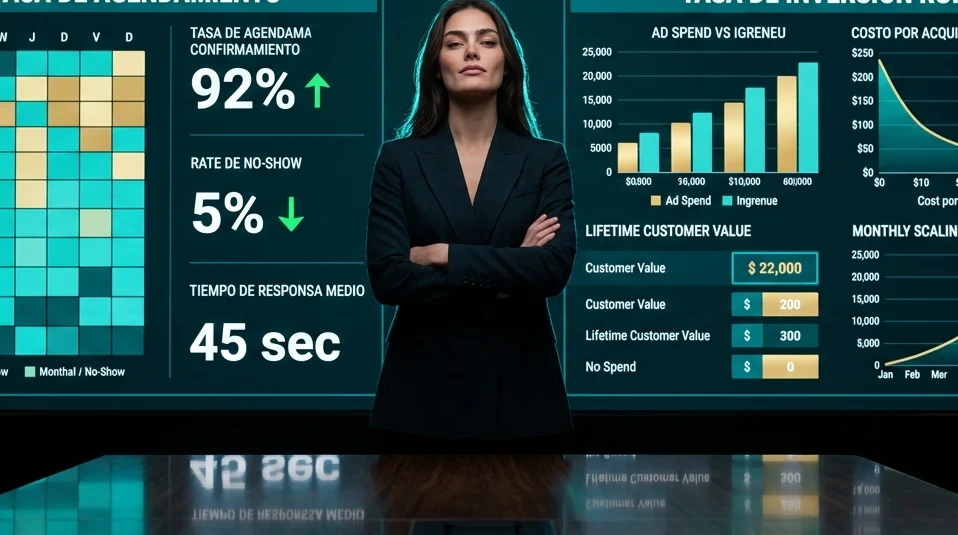
Qualitative Metrics Will Become More Valuable Than Quantitative Metrics
We are entering a different phase of the market.
- Attention is limited.
- Customers compare options faster.
- Technological competition increases every month.
In that environment, understanding human behavior becomes more important than simply accumulating data.
That is why the most advanced companies no longer ask only:
“How many leads arrived?”
Now they ask:
- What intent did they have?
- Which objection appeared repeatedly?
- What emotions emerged?
- Which conversation converted best?
- Which experience generates more trust?
That is exactly what AI-powered analytics makes possible.
It is not only about measuring activity. It is about understanding the behavior of potential customers.
The Modern Salesperson Needs Context, Not Just Leads
For years, people believed that selling better meant working more.
- More calls.
- More follow-up.
- More volume.
Today, that is no longer sustainable.
The modern salesperson needs focus, and focus only appears when there are clear signals.
BIKY.ai helps identify:
- Priority opportunities
- Leads with stronger intent
- Churn risks
- Conversations that require human intervention
This frees up time for what truly drives business results: judgment, empathy, and strategy.
Conversion Rate Is an X-Ray of Your Company
Many companies view conversion as an isolated metric.
In reality, it is a complete X-ray of the operation.
Because it reflects:
- Marketing clarity
- Operational speed
- Follow-up quality
- Customer experience
- Commercial alignment
- Execution capability
That is why improving conversion is not only about selling more. It is about operating better.
Conversion rate is not simply a sales KPI. It is a reflection of how intelligent, coordinated, and traceable an operation truly is.
Because a company that does not understand:
- How it converts
- Why it converts
- Which conversations generate revenue
The future does not necessarily belong to those who generate the most leads. It belongs to those who best understand the intent behind every interaction.
BIKY.ai does not just measure numbers. It connects conversations, context, behavior, and outcomes to transform data into real operational decisions. And in a market where every second of attention is increasingly valuable, that capability is no longer a competitive advantage.
It becomes survival and the future.