
The hidden operating costs that can destroy your business before you even realize it
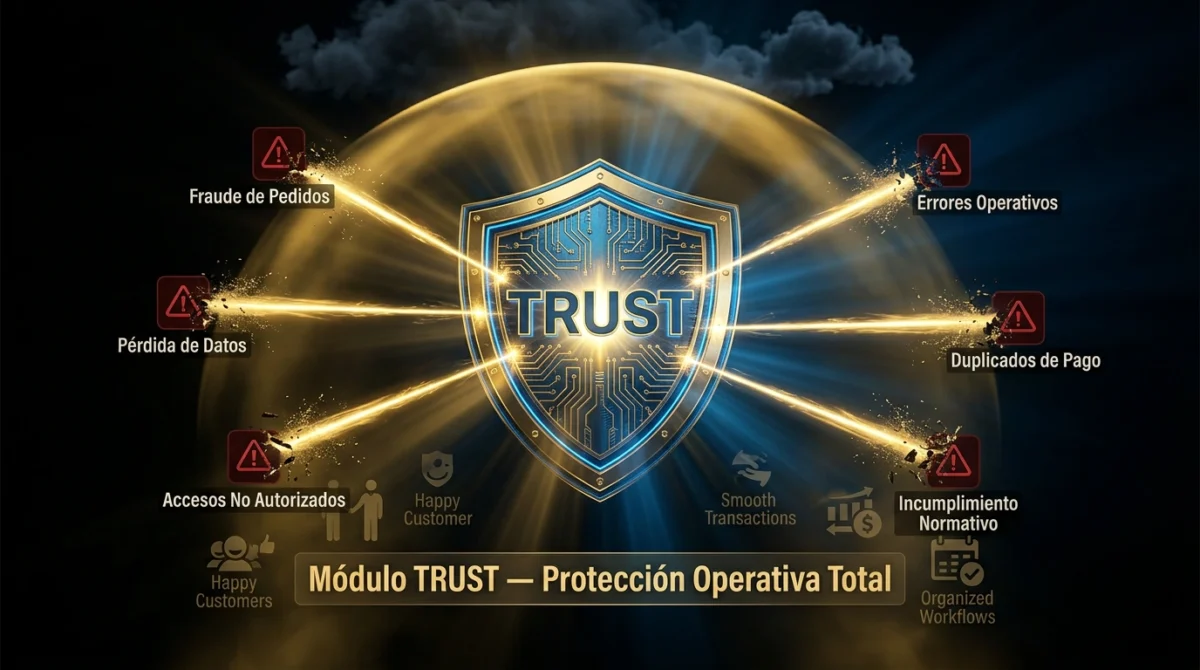
Many companies believe that their biggest losses stem from marketing, low sales, or aggressive competition. But some of the most costly issues begin with a false identity, a forged document, an untraceable onboarding process, or a business transaction lacking documentation.
For years, most commercial operations grew by prioritizing speed. More leads. More closed deals. More automation. However, very few companies asked themselves something fundamental: how secure is their operation really?
That is where the true invisible operational costs appear. Because modern fraud no longer enters only through sophisticated cyberattacks. Many times, it enters through weak commercial processes, manual verifications, or uncontrolled conversations.
And the most dangerous part is that the problem is usually detected far too late. When financial loss, reputational damage, or regulatory risk has already occurred.
That is why today, building a secure operation is no longer just a legal issue. It is a strategic growth decision.
Operational fraud no longer looks like fraud
One of the biggest mistakes companies make is imagining fraud as something obvious.
Many leaders still think about hackers, massive theft, or external attacks. However, much of the real damage happens inside seemingly normal processes:
- An altered document
- A stolen identity
- A fake supplier
- An incomplete verification
- A file without traceability
- A customer who was never truly verified
The problem is that those small cracks end up multiplying operational costs without the organization noticing at first.
And that is where a dangerous paradox appears.
While companies invest millions in customer acquisition, many still validate identities manually through email, PDFs, or screenshots sent over WhatsApp.
Growth accelerates, but protection does not.
The real cost is not always financial: it is also reputational
When a company faces an incident related to fraud, impersonation, or regulatory issues, the damage rarely ends with money.
It also affects:
- Trust
- Brand perception
- Credibility
- Customer relationships
- Ability to scale
- Operational stability
And that has much deeper consequences because recovering reputation is often more expensive than recovering revenue.
Especially in industries where trust defines the purchase decision:
- Financial services
- Automotive
- Real estate
- Healthcare
- Insurance
- Fintech
- High-value retail
In those sectors, poor validation can destroy years of positioning.
That is why a secure commercial operation is no longer solely the responsibility of legal or compliance departments. It is now part of the business itself.
Invisible operational costs appear when onboarding creates friction
Many companies believe that identity verification necessarily slows down the commercial process.
However, the opposite is true. When onboarding is confusing, manual, or repetitive, abandonment increases and operational costs skyrocket.
Modern customers do not want to:
- Fill out endless forms
- Repeat information
- Switch channels
- Wait days for validation
- Send documents multiple times
Every extra action cools down intent and directly affects conversion.
BIKY.ai understands that exact problem and, with its TRUST module, turns validation and compliance into an operational layer integrated into the commercial flow.
That allows KYC and KYB processes to run directly inside WhatsApp, where the customer already is.

Identity verification can no longer depend on human judgment alone
One of the most common problems in commercial operations is assuming teams will manually detect inconsistencies.
But operational reality is different because when volume grows:
- Human error appears
- Signals are missed
- Altered documents are approved
- Inconsistencies are ignored
- Evidence gets lost
And that silently scales risk.
BIKY.ai TRUST automates validation processes using:
- Biometrics
- Liveness detection
- Document verification
- Risk lists
- Digital signals
- End-to-end traceability
The goal is not to replace human supervision. It is to reduce operational vulnerability.
Because a company should not depend solely on someone “noticing something strange.”
An operation without traceability is a vulnerable operation
Many companies believe they have control because they store documents. But storing documents does not mean having traceability.
The difference is critical because traceability means understanding:
- What happened
- When it happened
- Who approved it
- What evidence exists
- Which validations were executed
- Which action triggered the system
Without that, any audit becomes slow, expensive, and risky.
And another silent problem appears: misalignment between departments.
- Marketing operates separately
- Sales operates separately
- Compliance arrives too late
- Operations tries to fix everything afterward
The result is a fragmented company.
TRUST connects validation, conversation, and CRM within a single operational architecture so every decision is recorded with context and evidence.
That not only improves compliance, it also improves operational speed.
Operational costs increase when fraud enters the commercial funnel
There is a dangerous belief that fraud is only a financial problem.
It is not. It also destroys efficiency.
And when an operation fails to detect risks early:
- Teams lose time
- Cases are manually reviewed
- Validations are duplicated
- Rework increases
- CAC rises
- Closings slow down
In other words: fraud also consumes productivity.
That is why BIKY.ai TRUST does not function as an isolated checklist. It operates as part of the commercial operating system.
Validation automatically feeds:
- CRM
- CDP
- Operational rules
- Approvals
- Escalations
- Automations
That transforms security into execution.
And that is where an important shift appears: the company stops reacting late and starts operating preventively.

The future of sales requires verifiable trust
Artificial intelligence accelerated commercial operations.
But it also increased risks. Today it is easier to:
- Falsify information
- Manipulate documents
- Automate fraud
- Create synthetic identities
That is why modern growth needs a new layer: verifiable trust.
And that trust cannot depend only on internal policies or manual processes. It must integrate directly into the commercial flow.
TRUST allows validation, evidence, and compliance to run inside WhatsApp without taking the customer out of the conversation. That reduces friction while strengthening security.
And that balance will become increasingly important because companies that grow quickly without governance will likely face much larger invisible costs later.
The human experience improves when security is intelligent
There is another common mistake: believing compliance and customer experience are enemies.
Not necessarily.
When security is poorly designed, it does create friction. But when it is integrated into the context, the opposite happens:
- Less repetition
- Less uncertainty
- Less downtime
- Fewer errors
- More trust
The experience improves because customers feel continuity.
At the same time, human teams stop exhausting themselves with repetitive manual validation tasks.
That is where one of the greatest values of well-implemented AI appears: freeing human time for more strategic decisions.
Because the goal is not to fill the company with controls. The goal is to create a reliable operation that can grow without breaking.
A secure company also sells better
Many organizations still see compliance as a cost. However, the most advanced companies already understand something different: trust accelerates conversion.
When customers perceive:
- Clarity
- Security
- Continuity
- Professionalism
- Traceability
the relationship changes completely.
Sales stop competing only on price and start competing on trust.
And that has a direct impact on:
- Conversion
- Retention
- Repurchase
- Reputation
- Lifetime value
That is why TRUST should not be understood only as a validation tool. It should be understood as commercial infrastructure designed to grow with less risk and better decisions.
The biggest operational risks rarely begin as visible crises. They begin with:
- An incomplete validation
- A weak file
- A false identity
- An altered document
- A conversation without traceability
And when they finally explode, operational costs are already much higher.
That is why the companies that will grow sustainably will not only be the ones that sell faster. They will be the ones capable of combining:
- Speed
- Automation
- Human experience
- Artificial intelligence
- Compliance
- Operational traceability
That is where BIKY.ai TRUST creates a structural difference.
Because in the new commercial environment, growing without trust is no longer scalability. It is vulnerability.